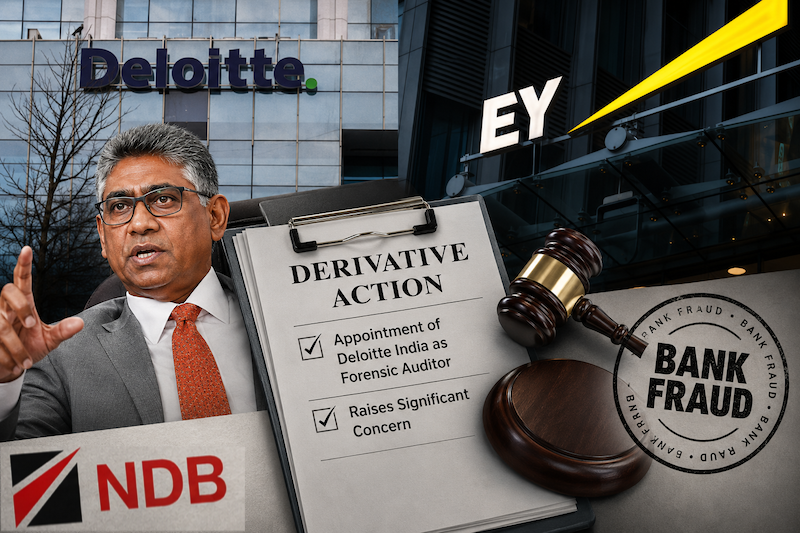
The derivative action filed against National Development Bank PLC (“NDB”), its Board of Directors and external auditors Ernst & Young has now evolved into a far broader controversy involving not only the underlying Rs. 13.2 billion fraud, but also the legitimacy, independence and maintainability of the legal proceedings themselves.
In a corporate disclosure issued to the Colombo Stock Exchange on 11 May 2026, NDB confirmed that minority shareholder M. Thiyagaraja had instituted proceedings in the Commercial High Court of the Western Province under case number 21/2026/CO. The bank further disclosed that when the matter was taken up on 8 May 2026, submissions focused largely on procedural objections relating to notice and maintainability, with court reserving its order for 13 May 2026.
The litigation arises against the backdrop of NDB’s own disclosures concerning what initially appeared to be a Rs. 380 million fraud before later escalating dramatically to approximately Rs. 13.2 billion. According to pleadings referred to in public reporting, the alleged fraud is said to have operated over nearly 21 months through the bank’s CEFTS settlements system, involving misuse of credentials, failures in segregation-of-duty controls and alleged diversion of funds through external entities and cryptocurrency channels.
However, legal observers increasingly suggest that the more immediate issue before court may not be the fraud itself, but whether the derivative action satisfies the strict legal thresholds required under Sri Lanka’s Companies Act No. 7 of 2007.
Derivative actions are exceptional remedies. They are not intended to become instruments of publicity campaigns, boardroom power struggles or strategic litigation designed to shift institutional accountability. Sri Lankan courts traditionally require a shareholder seeking derivative relief to demonstrate good faith, procedural compliance and clear necessity for intervention on behalf of the company.

Several legal analysts now argue that the present proceedings raise serious concerns on each of those fronts.
One issue attracting particular scrutiny is whether the litigation is genuinely intended to protect the company or whether it is indirectly serving the interests of the very directors whose conduct may ultimately require examination.
Critics argue that a troubling contradiction has emerged. While the derivative action publicly projects itself as a challenge to the board and management, much of the practical structure surrounding the litigation appears capable of insulating the directors from deeper independent scrutiny.
This concern became sharper following revelations that the board itself reportedly appointed Deloitte Touche Tohmatsu India LLP as the forensic auditor to investigate the fraud.
The petition reportedly questions whether a board potentially facing scrutiny over internal controls, oversight failures, audit supervision and governance deficiencies can legitimately appoint, scope, supervise, remunerate and control the very forensic investigation examining those issues.
That concern goes directly to the principle of independence.
But legal commentators now raise an even broader question: whether the derivative proceedings themselves risk becoming part of a controlled institutional strategy rather than a genuinely adversarial shareholder action.
Some observers fear the litigation could ultimately provide the directors with procedural cover to argue that “independent legal proceedings” and “forensic investigations” are already underway, thereby enabling the board to retain operational control over the narrative, the scope of inquiry and the flow of information while simultaneously presenting an appearance of accountability.
In effect, critics question whether shareholders are being invoked without any actual shareholder mandate.
No publicly known shareholder resolution appears to have authorized the board to deploy corporate resources, legal teams or institutional machinery in ways that may ultimately operate to shield directors from personal exposure. This raises legitimate concern over whether shareholder interests are truly aligned with the present litigation strategy or whether the bank itself is effectively being used as a defensive vehicle for management and board protection.
Corporate governance specialists note that derivative actions were designed precisely to prevent situations where alleged wrongdoers retain effective control over investigations into themselves. If the structure of the proceedings leaves directors exercising indirect control over litigation strategy, investigative architecture, disclosure management or forensic processes, the court may need to examine whether the action has become structurally compromised.
Another major vulnerability concerns procedural maintainability.
NDB’s own disclosure confirms that the Commercial High Court heard arguments specifically relating to procedural notice requirements. Under Sri Lankan company law, procedural defects in derivative actions are often fatal. Courts have historically insisted upon strict compliance with statutory prerequisites relating to standing, notice, pleadings and leave of court before permitting derivative proceedings to continue.
Commercial law practitioners therefore suggest that the court’s threshold ruling may become more important than the substantive allegations themselves. If the proceedings fail at the maintainability stage, the action could be dismissed without the court ever entering into the merits of the accusations.
The inclusion of Ernst & Young also introduces a demanding evidentiary burden. Claims against external auditors generally require proof of serious negligence, recklessness, concealment or material breach of professional standards rather than mere hindsight criticism following financial loss.
At the same time, the underlying governance questions remain difficult to ignore.
The petition reportedly points to an extraordinary rise in balances categorized under “Other Financial Assets” and CEFTS-related receivables between 2023 and 2025, arguing that such movements should have attracted scrutiny from both management and auditors.
Yet critics caution that if the present proceedings merely produce a tightly managed forensic process controlled through institutional channels connected to the existing board, the litigation risks undermining rather than restoring public confidence.
Banks occupy a special position in the economy because they hold public deposits and operate on trust. Consequently, governance failures inside licensed financial institutions cannot be treated as ordinary corporate disputes.
That is why some corporate observers now argue that the Commercial High Court should rigorously examine whether this derivative action is genuinely advancing shareholder interests or whether it has evolved into a mechanism through which directors may effectively use the bank’s own institutional and financial resources to navigate, contain or strategically manage personal governance exposure.
If the court concludes that the proceedings are structurally conflicted, procedurally defective or lacking genuine independence, it may refuse leave, dismiss the action or insist upon far stricter judicial supervision before allowing the litigation to proceed further.
The Commercial High Court’s ruling on maintainability is therefore expected to carry implications far beyond NDB itself. It may define how Sri Lankan courts approach future attempts to use derivative litigation in the banking sector, particularly where questions arise over board control, forensic independence and the use of corporate machinery in disputes ostensibly brought in the name of shareholders.