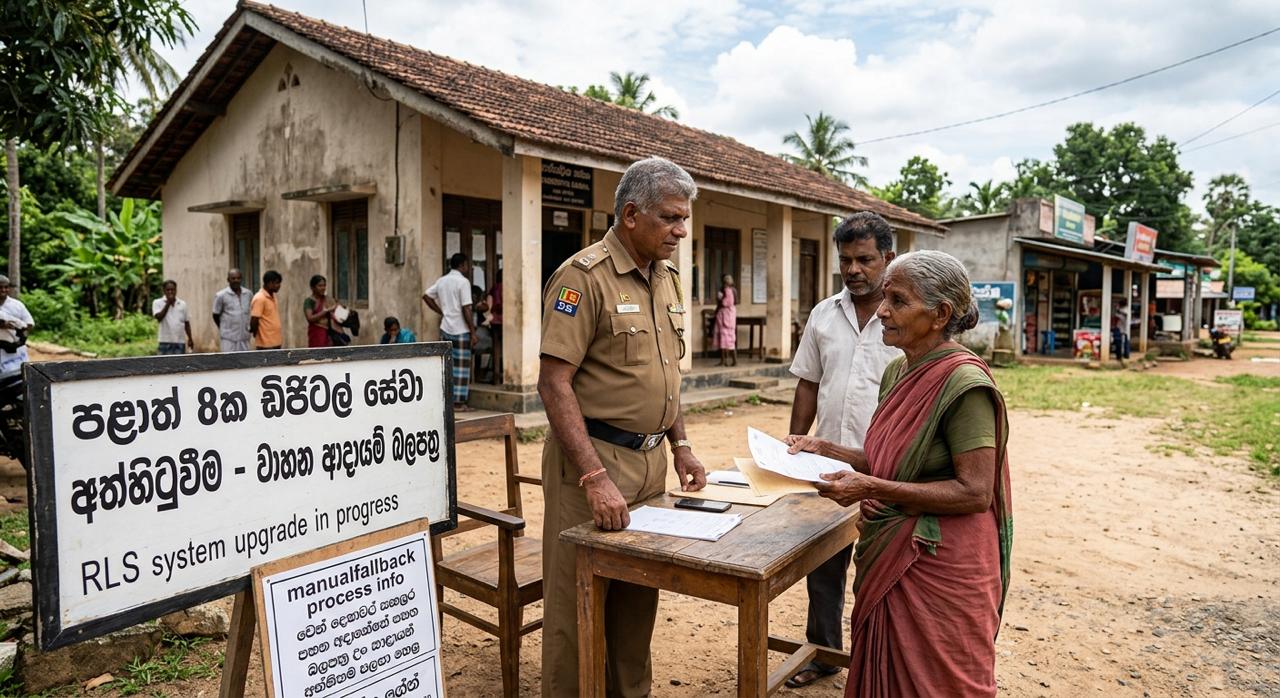
Sri Lanka wants more government services online. This weekend provides a small but important test of what that promise means in practice: the electronic vehicle revenue-licensing system is unavailable across eight of the country’s nine provinces while its infrastructure is upgraded.
From Friday until Monday, motorists across most of Sri Lanka will be unable to obtain electronic vehicle revenue licences through the eRL 2.0 system.
The interruption affects the Central, North Central, North Western, Southern, Eastern, Northern, Sabaragamuwa and Uva provinces. Only the Western Province is excluded. The authorities say normal operations are expected to resume on Tuesday, September 29.
Submit Your Press Release
Get your company news, announcements, launches, appointments and events in front of a wider audience.


The explanation is straightforward.
The system requires what the authorities describe as an infrastructure upgrade intended to improve the efficiency and quality of the electronic revenue-licensing service.
Systems need maintenance. Technology needs upgrading. There is nothing particularly remarkable about either.
But there is a larger question worth asking as Sri Lanka moves rapidly towards digital government.
What happens to the citizen when the digital State goes offline?
The question is becoming increasingly relevant because more interactions between Sri Lankans and their Government are moving away from paper, counters and discretionary human processes towards databases and interconnected electronic systems.
That transformation has enormous potential benefits. A properly designed digital service can eliminate journeys to government offices, reduce queues, create an electronic audit trail, limit opportunities for petty corruption and allow a citizen to complete in minutes something that once consumed half a working day.
But digitalisation also changes the nature of failure.
When a government counter is closed, another counter may sometimes remain available. When the central electronic system upon which an entire service depends is unavailable, the consequences can potentially extend across a province – or, as this weekend demonstrates, eight of them.
The present interruption is planned rather than a system failure. The public has been given advance notice, and authorities say the purpose is to improve the system. That distinction is important.
But planned downtime still provides a useful opportunity to ask whether Sri Lanka is designing sufficient resilience into its digital State.
Can essential transactions continue when a system is unavailable? Is there a manual fallback? What happens when a deadline expires during downtime? Will a motorist ever be penalised because the Government’s own system prevented a licence being renewed?
These questions become more important as the number of services dependent upon digital identification and government databases grows.
From November, as NewsLine reports elsewhere in this edition, the TIN will become necessary for a range of transactions involving banks, vehicles, land, businesses and credit cards.
One policy expands the reach of digital administration. Another event reminds us how dependent citizens become upon the infrastructure supporting it.
That does not make digitalisation undesirable.
Quite the opposite.
Sri Lanka should be moving government services online. A country in which citizens can deal with the State from a telephone or computer rather than carrying files between desks is a country capable of becoming more efficient.
But efficiency cannot be the only measure of success.
Reliability matters. Cybersecurity matters. Data accuracy matters. Redundancy matters. And there must be a workable route for a citizen whose transaction is blocked because the Government’s technology – rather than the citizen – has failed.
The eRL system is expected to return on Tuesday with upgraded infrastructure.
For most motorists, this weekend’s interruption will probably amount to little more than an inconvenience.
But the principle is considerably larger.
As Sri Lanka builds a State increasingly dependent upon technology, it must build something else alongside it.
A way for the citizen to function when the technology does not.