Sri Lanka’s democratic transformation cannot be measured exclusively by the number of powerful individuals appearing before courts. The real test is whether the institutions, economic opportunities and everyday circumstances of ordinary citizens are changing for the better.
There is a temptation in politics to confuse the visible with the valuable.
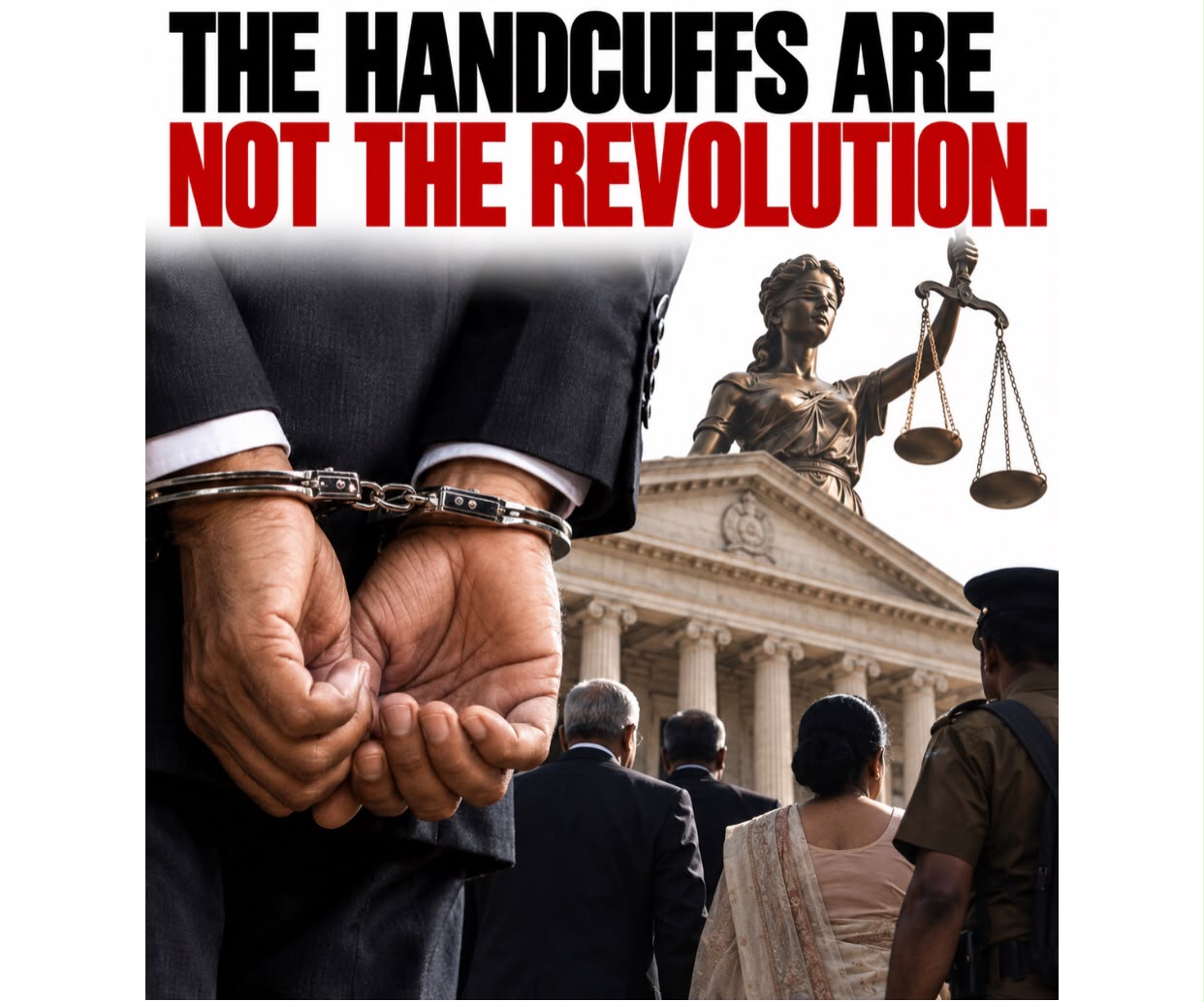
An arrest is visible. A former minister entering a courtroom is visible. A once-powerful official being escorted into remand custody provides an image capable of travelling across television screens and social media within minutes.
Submit Your Press Release
Get your company news, announcements, launches, appointments and events in front of a wider audience.


The rebuilding of an economy is considerably less dramatic.
It involves institutions functioning properly, businesses investing, workers earning better wages, farmers receiving fair returns, hospitals obtaining essential medicines and children having opportunities that their parents were denied.
None of these achievements necessarily produces a memorable photograph.
Yet they are the substance of national progress.
Sri Lanka’s present Government came to office promising change. It received a mandate of unusual strength, first through the election of Anura Kumara Dissanayake as President and subsequently through the National People’s Power’s overwhelming parliamentary majority.
That mandate reflected widespread dissatisfaction with the political and economic arrangements that had governed the country for decades.
Corruption was part of that dissatisfaction. So were economic hardship, unequal opportunity, ineffective institutions and the perception that political connections frequently mattered more than ability or honesty.
The electorate was asking for something more substantial than a change of personalities.
It was asking for a different relationship between the State and the citizen.
Two years later, the country is witnessing developments that would once have seemed improbable.
Former presidents, political figures, senior officials and individuals associated with previous administrations have become subjects of criminal investigations and judicial proceedings.
There is nothing inherently improper about that.
Where credible evidence suggests that offences have been committed, the law must be permitted to operate regardless of the identity or former position of the individual concerned.
Indeed, equality before the law becomes meaningless if it applies only to those without political influence.
But the reverse principle is equally important.
No person should be presumed guilty because he or she once exercised political power, belonged to an unpopular administration or carries a familiar surname.
The courts must determine guilt. Investigators must establish facts. Prosecutors must prove their cases.
The Government must not be permitted to claim convictions that have not occurred, just as the Opposition must not be permitted to describe legitimate investigations as persecution merely because they concern its members.
Justice requires something more disciplined than political enthusiasm.
And it requires patience.
A functioning criminal justice system will sometimes convict. It will sometimes acquit. It will sometimes reject applications, dismiss proceedings or find that investigators have failed to establish the necessary evidence.
These outcomes are not necessarily signs of institutional weakness.
They are consequences of a system in which the State must prove its allegations rather than demand that citizens disprove them.
Sri Lanka should welcome that principle regardless of who happens to be standing in the dock.
But justice, however important, cannot become the entirety of the national conversation.
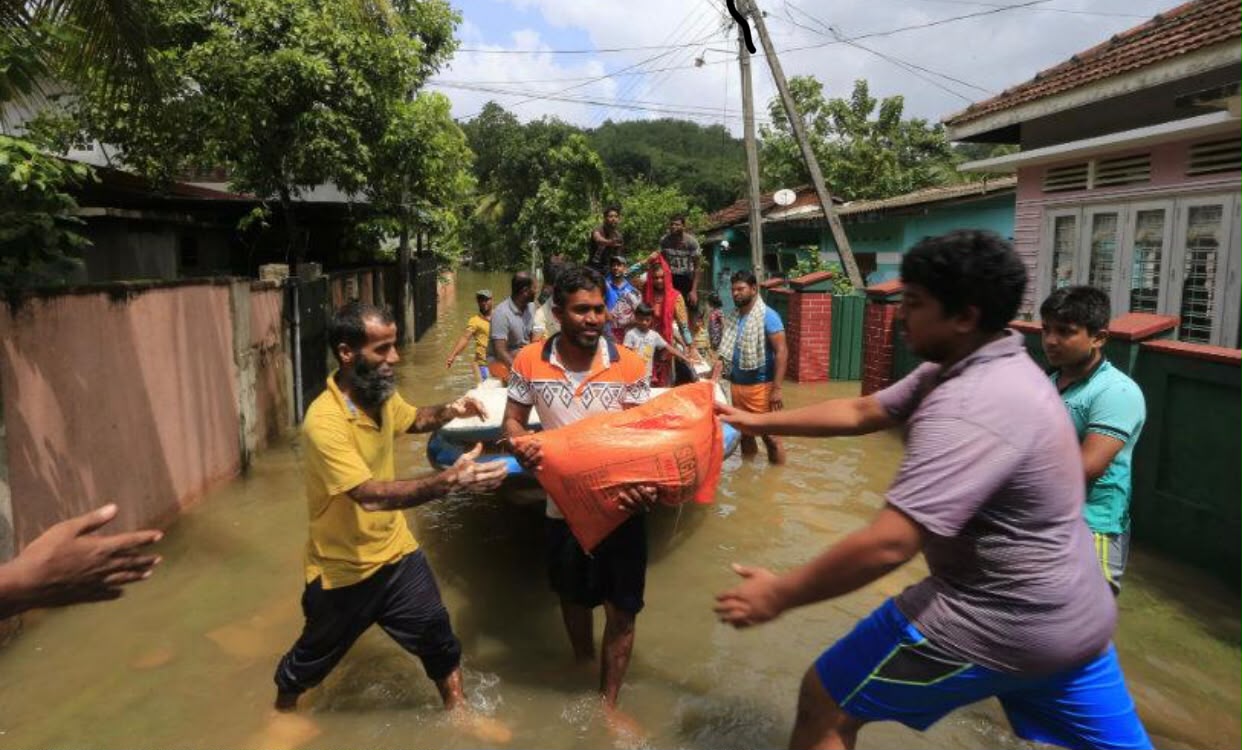
The economic crisis of 2022 was not simply a political embarrassment. It destroyed savings, disrupted livelihoods, increased poverty and imposed extraordinary hardship upon millions of people.
The recovery has been real in important respects.
Economic growth has returned. Inflation has moderated. External financial stability has improved.
The Government is entitled to acknowledge those developments.
But it must also acknowledge that macroeconomic recovery does not automatically restore the living standards of ordinary households.
A worker whose salary has failed to keep pace with accumulated increases in living costs may find little comfort in a positive GDP figure.
A pensioner struggling to purchase medicine does not experience economic recovery through an announcement concerning foreign exchange reserves.
A young graduate unable to secure suitable employment may regard political change as incomplete, regardless of the number of former officials appearing before court.
These are not unreasonable expectations.
They are the expectations upon which democratic mandates are ultimately judged.
There is also a deeper connection between justice and prosperity.
Corruption diverts resources, distorts competition and weakens public institutions. It discourages investment and undermines confidence in the fairness of economic opportunity.
Reducing corruption should therefore contribute to better economic outcomes.
But that contribution must eventually become visible.
The country needs transparent procurement, credible regulation, functioning public services, productive investment and a tax system that is both effective and equitable.
It needs an administration capable of delivering decisions without unnecessary delay and institutions that serve the public rather than the convenience of those who control them.
Those are reforms that matter long after individual criminal cases have concluded.
The Government should also recognise that public expectations naturally evolve.
At the beginning of a new administration, citizens may be prepared to accept explanations about inherited difficulties and the time required to correct them.
As months become years, the demand changes.
People increasingly want to know what has improved, what remains unfinished and when the benefits of reform will reach them.
That is not necessarily a rejection of the Government. It is the ordinary process through which democratic accountability operates.
Nor should the Government regard criticism as evidence of hostility.
A strong administration should be capable of explaining its achievements, acknowledging shortcomings and correcting mistakes without treating every question as a political attack.
The Opposition carries responsibilities of its own.
It cannot credibly demand economic improvement while refusing to confront the failures that contributed to the country’s collapse. Nor can it expect public confidence to return merely because those presently governing encounter difficulties.
Sri Lanka requires a political culture in which governments are judged by performance and oppositions are judged by the credibility of their alternatives.
The public deserves more than competing accusations.
It deserves functioning institutions, honest explanations and measurable results.
The great danger is that political theatre, whether conducted through accusations, arrests, parliamentary confrontations or triumphant declarations, becomes a substitute for the quieter work of governing.
That would be a profound disappointment.
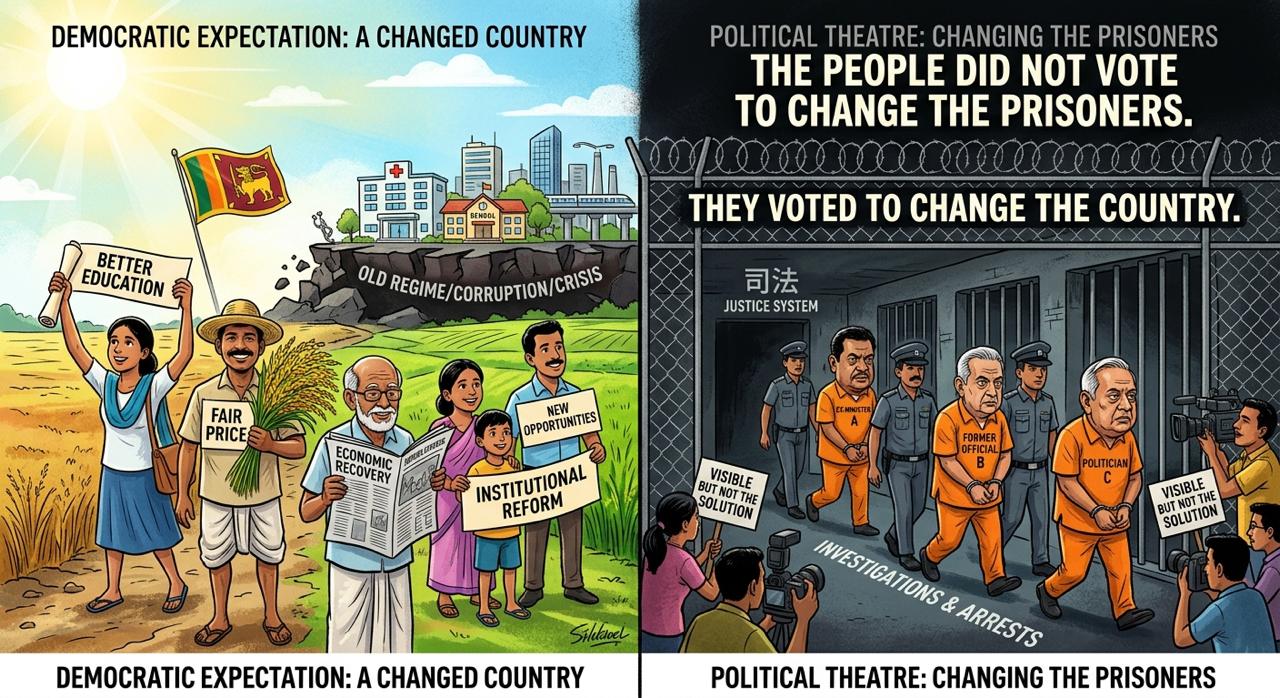
The people who voted for change were not simply expressing a preference about who should exercise authority.
They were demanding a country in which authority would be exercised differently.
A country where the law protects everyone, where public money is treated as a public trust, where opportunity does not depend upon political patronage and where economic progress reaches beyond the privileged few.
The Government has the numbers in Parliament. It has the constitutional authority to pursue reform. It has the political mandate to challenge entrenched practices.
What it must now demonstrate is the ability to convert those advantages into durable improvements in the lives of citizens.
That is the standard by which meaningful change should be assessed.
Not the number of people arrested, not the volume of political rhetoric and not the frequency of official announcements.
The standard is whether Sri Lanka becomes more just, more prosperous and more equitable.
The people did not vote merely to change the occupants of public office or the identities of those facing criminal proceedings.
They voted in the expectation that their country could be governed better.
Be that as it may.