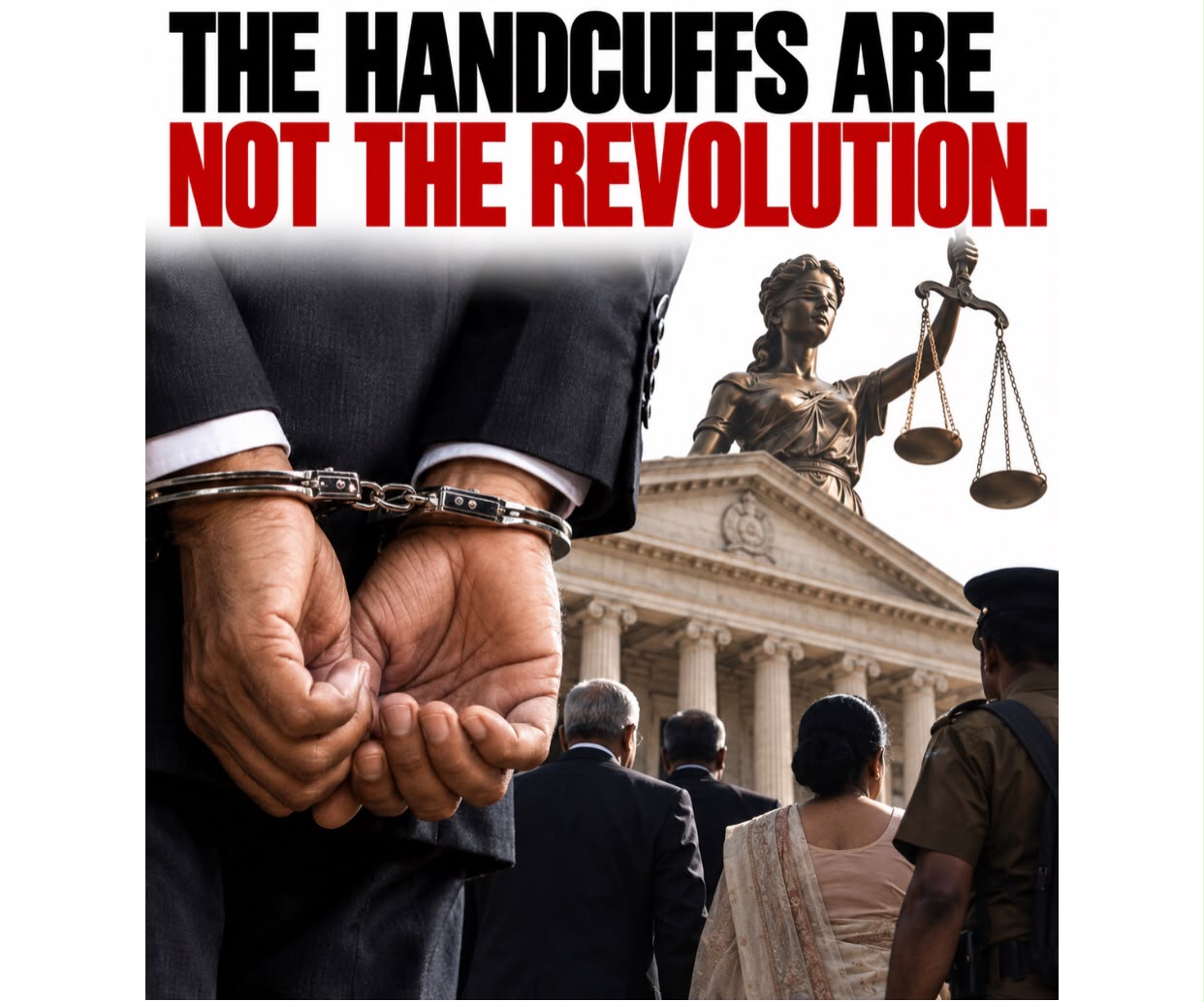
Sri Lanka is witnessing something unusual. Former presidents, former first ladies, political heirs, senior police officers and other once-powerful figures are entering courts, remand prisons and criminal investigations. For a country accustomed to believing that power carried immunity, this is significant. But an arrest is not justice, remand is not a conviction and humiliation is not reform.
There is an understandable satisfaction among many Sri Lankans when somebody once regarded as politically untouchable is taken before a court.
It comes from history.
Submit Your Press Release
Get your company news, announcements, launches, appointments and events in front of a wider audience.


For decades the public watched governments promise investigations into the previous government. Files were opened, commissions appointed and spectacular allegations made. Elections changed the people in office, but remarkably few major cases travelled all the way from investigation to judgment.
The result was cynicism. Sri Lankans began assuming that powerful people did not really go to prison, at least not for long, and that political accountability existed mainly during election campaigns.
The present period therefore feels different.
Former President Ranil Wickremesinghe was remanded earlier. Namal Rajapaksa has been remanded. Shiranthi Rajapaksa has now been remanded. Former IGP Deshabandu Tennakoon is before the High Court in a separate matter. Investigative agencies are visibly active and the NPP Government can argue that political status no longer automatically prevents the machinery of law enforcement from moving.
If that is what is happening, Sri Lanka should welcome it.
But we should be very careful about what exactly we celebrate.
The sight of a political opponent in handcuffs can be emotionally satisfying. It can also be democratically dangerous if the handcuffs themselves become proof of guilt in the public imagination.
They are not.
A government committed to ending impunity must be more protective of due process than the governments it criticises, not less. It must demand better investigations, stronger evidence and properly constructed prosecutions because its objective should be convictions where crimes can be proved and acquittals where they cannot.
The alternative is accountability as spectacle.
That produces dramatic arrests, crowded courthouses, breaking-news banners and photographs of prominent people being transported to prison. Months or years later cases weaken, witnesses become unreliable, procedural defects emerge and the prosecution collapses.
Sri Lanka has already seen enough of that.
Every failed politically sensitive prosecution has two victims. The first is the credibility of the justice system. The second is the possibility of ever establishing what actually happened, because an acquitted politician can then portray the entire investigation as proof of persecution.
The NPP therefore carries a burden created partly by its own promises.
It campaigned against corruption more aggressively than almost any governing party in recent Sri Lankan history. Its supporters consequently expect results and the Government will inevitably feel pressure to demonstrate that those results are being delivered.
That pressure must never reach an investigator, prosecutor or judge.
There is an important difference between creating the conditions in which law enforcement can operate without interference and expecting law enforcement to produce politically useful outcomes.
The first is reform. The second is merely the old system wearing different colours.
The same principle applies to the people now being investigated.
The Rajapaksa name cannot constitute evidence. Ranil Wickremesinghe’s former office cannot constitute evidence. Deshabandu Tennakoon’s history cannot constitute evidence. Public dislike cannot constitute evidence.
Evidence constitutes evidence.
That may sound obvious, but periods of political transition are precisely when obvious principles require repetition.
There is another measurement of change that receives much less attention. How does the law treat somebody without a famous surname?
If a poor man is arrested, does he receive the same concern about due process? If a woman spends months in remand because her case cannot be concluded, does political Sri Lanka become equally exercised? If a suspect is assaulted inside a police station, is accountability pursued with the same enthusiasm?
Equality before the law cannot mean finally treating the powerful badly.
It means treating everybody properly. That is the revolution Sri Lanka should want.
It is less dramatic than a prison bus carrying a former First Lady. It does not produce the same television pictures. But it is infinitely more important.
A functioning justice system should eventually become boring. Investigations should be professional. Prosecutors should act independently. Courts should determine guilt. Politicians should stop commenting on outcomes they cannot legitimately control.
The powerful should fear committing crimes, not fear losing elections.
There is a profound difference.
President Dissanayake has an opportunity that few Sri Lankan leaders have possessed. He can help establish a culture in which a change of government does not automatically produce revenge against yesterday’s rulers but also does not protect them from genuine investigation.
If that culture takes root, it will eventually protect the NPP too.
One day this Government will no longer be the Government. That is democracy. Its ministers, officials and political appointees will then expect precisely the same protections of due process that today’s accused are entitled to demand.
The strongest justice system is therefore not one built to prosecute your opponents.
It is the one you would trust when your opponents control it.
Sri Lanka may indeed be witnessing the beginning of something important. Powerful people are discovering that a title, family name or former office may no longer be enough to prevent an investigation.
Good. Now comes the harder part. Prove the cases. Protect the innocent. Convict the guilty.
And build a system capable of doing both without first asking who they are.
Be that as it may.