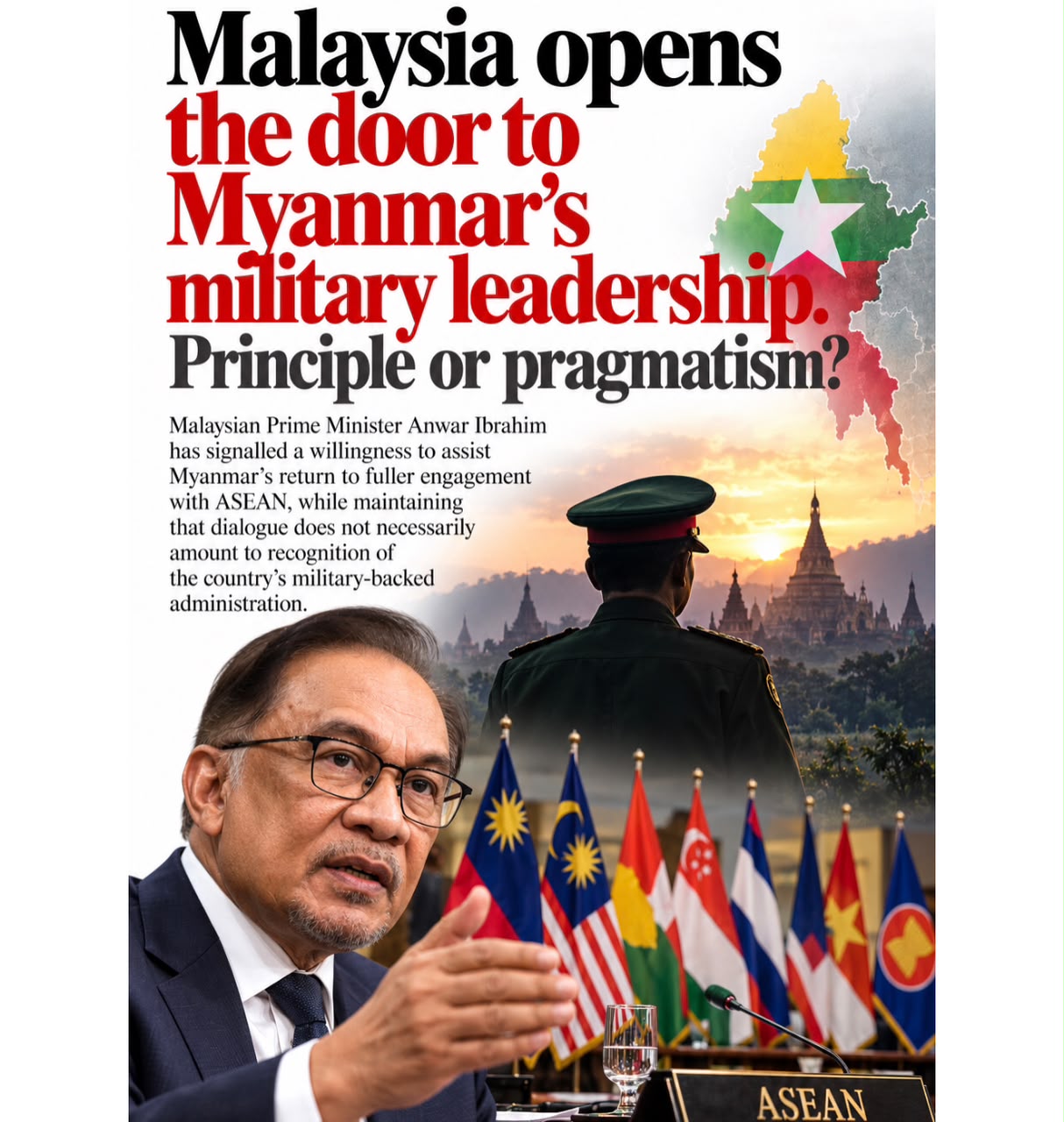
Malaysian Prime Minister Anwar Ibrahim has signalled a willingness to assist Myanmar’s return to fuller engagement with ASEAN, while maintaining that dialogue does not necessarily amount to recognition of the country’s military-backed administration. The initiative raises difficult questions about regional diplomacy, democratic legitimacy and the responsibilities of neighbouring countries towards millions of people affected by Myanmar’s prolonged political crisis.
Myanmar’s political crisis has presented the Association of Southeast Asian Nations with one of the most difficult challenges in its history.
The military’s seizure of power in February 2021 disrupted the country’s democratic transition, triggered widespread opposition and contributed to an increasingly destructive conflict involving the armed forces, resistance organisations and ethnic armed groups.
Submit Your Press Release
Get your company news, announcements, launches, appointments and events in front of a wider audience.


The humanitarian consequences have been severe. Large numbers of civilians have been displaced, economic activity has suffered and communities across the country have experienced insecurity and hardship.
ASEAN has struggled to develop an effective collective response.
Its traditional emphasis on consensus, non-interference and diplomatic engagement has encountered the reality of a crisis in which political divisions and armed conflict have made meaningful progress exceptionally difficult.
Malaysia has frequently been among the more outspoken ASEAN members concerning the situation in Myanmar.
Prime Minister Anwar Ibrahim’s recent comments suggesting a willingness to facilitate Myanmar’s reintegration into regional engagement therefore deserve attention.
The Malaysian position appears to distinguish between maintaining diplomatic contact with Myanmar’s military leadership and formally recognising the legitimacy of the administration established following the coup.
That distinction is important, but it is not without complications.
Diplomatic engagement can provide opportunities to discuss humanitarian access, political dialogue, refugee protection and measures intended to reduce violence.
Refusing all contact may satisfy a political principle without necessarily improving conditions for civilians living under the consequences of conflict.
Conversely, engagement that produces no meaningful change risks being interpreted as acceptance of the existing political order.
ASEAN must therefore determine what it expects to achieve through renewed dialogue.
The organisation adopted a Five-Point Consensus in 2021, calling for an immediate cessation of violence, constructive dialogue among the parties concerned, mediation by a special envoy, humanitarian assistance and access for the envoy to meet relevant stakeholders.
Implementation has remained deeply problematic.
Any new diplomatic initiative should therefore be assessed against those commitments rather than presented simply as evidence of improved relations.
Malaysia also faces domestic and regional pressures arising from the presence of Myanmar nationals seeking refuge or employment.
Questions concerning the repatriation of migrants and refugees require particular care.
Returning individuals to a country experiencing armed conflict and political instability may expose them to serious risks, depending on their personal circumstances and the conditions in the areas to which they would be returned.
International humanitarian principles and applicable legal obligations must therefore inform decisions concerning repatriation.
The wider ASEAN community has an interest in preventing Myanmar’s instability from producing further regional consequences.
Cross-border crime, irregular migration, trafficking, disrupted trade and humanitarian emergencies do not remain confined within national boundaries.
Sri Lanka, although not an ASEAN member, has legitimate reasons to follow these developments.
The stability of Southeast Asia influences regional trade, maritime commerce and the wider political environment of the Indian Ocean.
There is also a broader diplomatic lesson.
Countries frequently confront situations in which maintaining principled positions and pursuing practical engagement appear to pull in different directions.
The challenge is to ensure that engagement serves identifiable objectives rather than becoming an end in itself.
Malaysia should therefore clarify what conditions it believes would justify Myanmar’s fuller participation in ASEAN processes and what measurable progress it expects from renewed contact.
Humanitarian access, protection of civilians and credible political dialogue would provide more meaningful indicators than the frequency of meetings between senior officials.
Be that as it may, Malaysia’s willingness to engage with Myanmar’s military leadership may reflect an attempt to break a prolonged diplomatic deadlock. But the success of that approach will not be determined by whether Myanmar’s rulers return to regional conference tables. It will depend on whether the people of Myanmar experience greater security, humanitarian protection and a credible prospect of political stability.