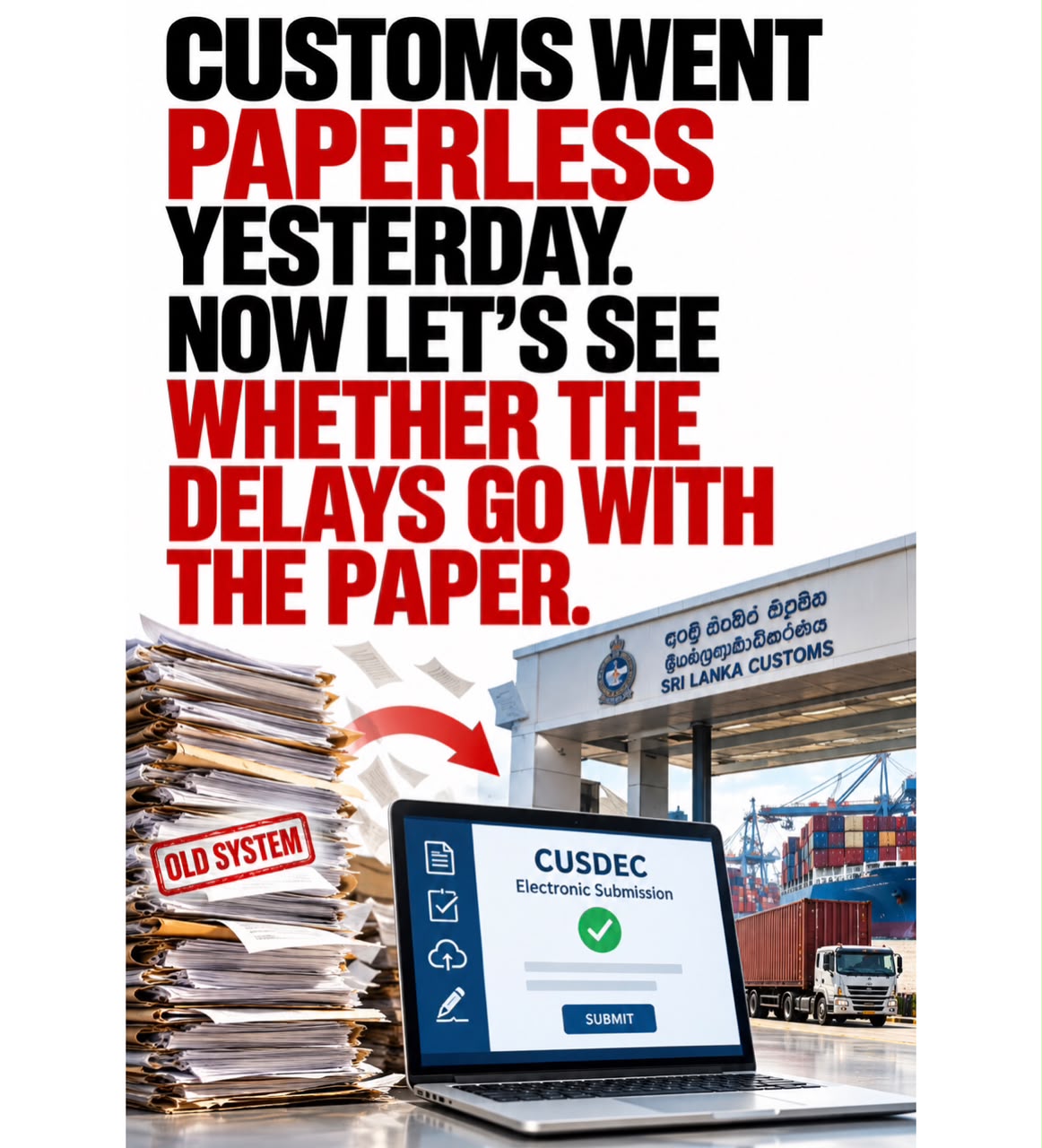
Sri Lanka Customs has stopped accepting the old manual Customs declaration process. From October 1, importers and declarants must submit CusDecs and supporting documents electronically using valid digital signatures. After years of talking about digital government, this is one change businesses should actually be able to measure.
The new process removes the requirement for traders and Customs brokers to physically carry bundles of documents to Customs counters.
Commercial invoices, packing lists, bills of lading, certificates of origin, permits and other supporting documents can now be submitted electronically through ASYCUDA. Customs officers review them electronically and queries can be dealt with through the system.
Submit Your Press Release
Get your company news, announcements, launches, appointments and events in front of a wider audience.


There is another important feature. Once a document has been digitally signed, subsequent alterations can be detected.
That is being presented as protection against fraud and corruption. It also creates something equally valuable: an audit trail.
Who submitted what? When? What changed? Who examined it? What decision followed?
Paper has a curious habit of becoming difficult to follow. Data is less accommodating.
Customs is one of the most important institutions in Sri Lanka’s economy. It collects enormous amounts of government revenue while simultaneously sitting between virtually every importer and the goods being brought into the country.
It therefore performs two functions which can sometimes pull in opposite directions.
It must protect revenue and enforce the law. It must also allow legitimate trade to move quickly.
A Customs administration that waves everything through is useless. A Customs administration that turns every legitimate shipment into an obstacle course is not much better.
Digitisation offers a way of doing both more intelligently.
Risk-based systems can identify suspicious transactions for closer inspection while allowing established, compliant traders to move goods more quickly. Electronic records can make patterns easier to detect. Automated comparison of declarations can expose unusual valuations and repeated anomalies.
But there is an important distinction. Paperless is not necessarily digital.
Scanning a piece of paper and emailing it merely creates an electronic piece of paper.
The real prize comes when the information inside the declaration becomes structured data capable of being compared automatically with other government information.
And that brings us neatly back to Parliament’s concern about discrepancies between banking and Customs records.
If an importer tells a bank that US$100,000 is required to purchase goods overseas, the corresponding Customs declaration should eventually become capable of being matched electronically against that payment.
Not after somebody asks for a file. Automatically.
That is where Customs modernisation begins becoming foreign-exchange protection as well as administrative convenience.
There will inevitably be teething problems. Digital signatures have to work. Systems need redundancy. Traders and agents have to learn the process. Customs officers need proper training. A computer outage cannot be allowed to close Sri Lanka’s import economy.
Those are implementation problems, not arguments for keeping paper.
Sri Lanka Customs says the new system should reduce waiting time, improve transparency, allow declarations to be tracked and strengthen accountability.
Excellent. Now measure it.
Tell the public the average Customs declaration processing time before October 1 and publish it again in three months. Tell us how many physical visits an importer previously needed and how many are required now. Tell us whether flagged discrepancies increase, whether clearance becomes faster and whether revenue leakage falls.
Be that as it may, yesterday Sri Lanka Customs removed the paper.
The interesting part starts today: whether it also removes the opportunities that used to hide behind it.