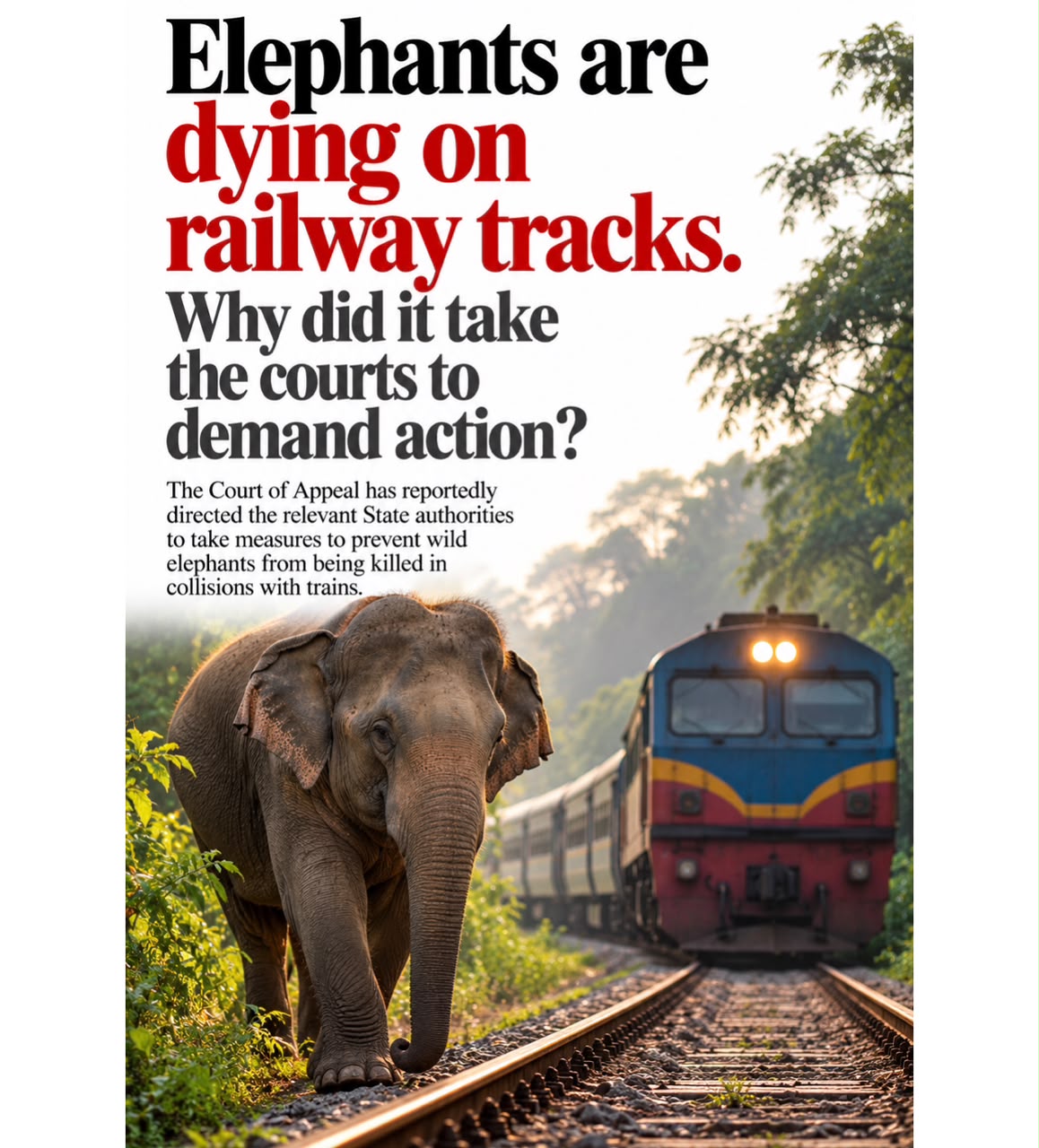
The Court of Appeal has reportedly directed the relevant State authorities to take measures to prevent wild elephants from being killed in collisions with trains. The intervention highlights a longstanding failure to reconcile railway operations with wildlife protection, raising questions about the effectiveness of preventive measures and the responsibilities of institutions entrusted with protecting one of Sri Lanka’s most important natural assets.
The death of a wild elephant on a railway track is not simply an unfortunate collision between an animal and a train. It represents a failure of prevention in circumstances where the risks are frequently known, the locations of recurring incidents can be identified and practical measures may be available to reduce the danger.
Sri Lanka’s elephants are an irreplaceable part of the country’s natural heritage. Their survival depends on access to habitats, feeding grounds and traditional movement corridors that increasingly intersect with roads, railways, settlements and agricultural land.
Submit Your Press Release
Get your company news, announcements, launches, appointments and events in front of a wider audience.


The expansion of human activity has made those encounters more frequent and, in many cases, more dangerous.
Railway collisions present a particularly serious problem because of the size and speed of trains and the limited opportunity available to drivers to avoid animals appearing on the tracks.
The consequences can be devastating for elephants. They can also endanger railway employees and passengers, damage rolling stock and disrupt essential transport services.
The reported intervention of the Court of Appeal should therefore be regarded as an important development in the continuing effort to reduce preventable wildlife deaths.
But it also raises an uncomfortable question.
Why should judicial intervention be necessary before the relevant authorities implement effective measures against a danger that has been recognised for years?
Sri Lanka possesses institutions responsible for wildlife conservation, railway operations, environmental management and public infrastructure. Each has a role in addressing the problem, yet the persistence of fatal collisions suggests that existing arrangements have not produced sufficiently effective results.
The first requirement is reliable information.
Authorities should identify the railway sections where elephant collisions occur most frequently, the times at which incidents are concentrated and the environmental conditions that contribute to the danger.
This information should guide practical interventions rather than allowing preventive measures to be introduced without adequate assessment.
Speed restrictions on high-risk railway sections may be necessary, particularly during periods when elephants are known to cross the tracks.
Early-warning systems, improved visibility, communication between wildlife officers and railway control centres, and technology capable of detecting animals approaching railway lines should also be considered.
However, no single measure is likely to eliminate the danger.
Elephants move according to environmental conditions, food availability and established behavioural patterns. Their movements cannot always be predicted with precision, and measures that appear effective in one location may be unsuitable elsewhere.
This makes cooperation between the Department of Wildlife Conservation and Sri Lanka Railways essential.
The agencies should establish clearly defined responsibilities, shared monitoring arrangements and procedures for responding rapidly when elephants are detected near railway lines.
There must also be accountability for implementation.
It is not enough to announce that measures will be introduced. The Government should publish the locations selected for intervention, the funding allocated, the completion timetable and the methods by which effectiveness will be assessed.
The financial implications deserve consideration, but so does the cost of continued inaction.
Railway collisions can result in damage to locomotives and infrastructure, operational delays and significant expenditure. Preventive investment may therefore protect both wildlife and public resources.
The broader issue concerns Sri Lanka’s approach to development and conservation.
Economic infrastructure is necessary, and railway services remain important to communities and businesses. But development cannot be regarded as successful if preventable environmental destruction is accepted as an unavoidable consequence.
Sri Lanka has long promoted its wildlife, particularly its elephants, as part of the country’s identity and tourism appeal. Protecting those animals must involve more than expressions of regret after another fatal collision.
Be that as it may, the Court of Appeal’s reported intervention should mark the beginning of measurable action rather than another round of administrative assurances. The question is not whether Sri Lanka values its elephants. It is whether the institutions responsible for their protection are prepared to take the practical steps necessary to keep them alive.