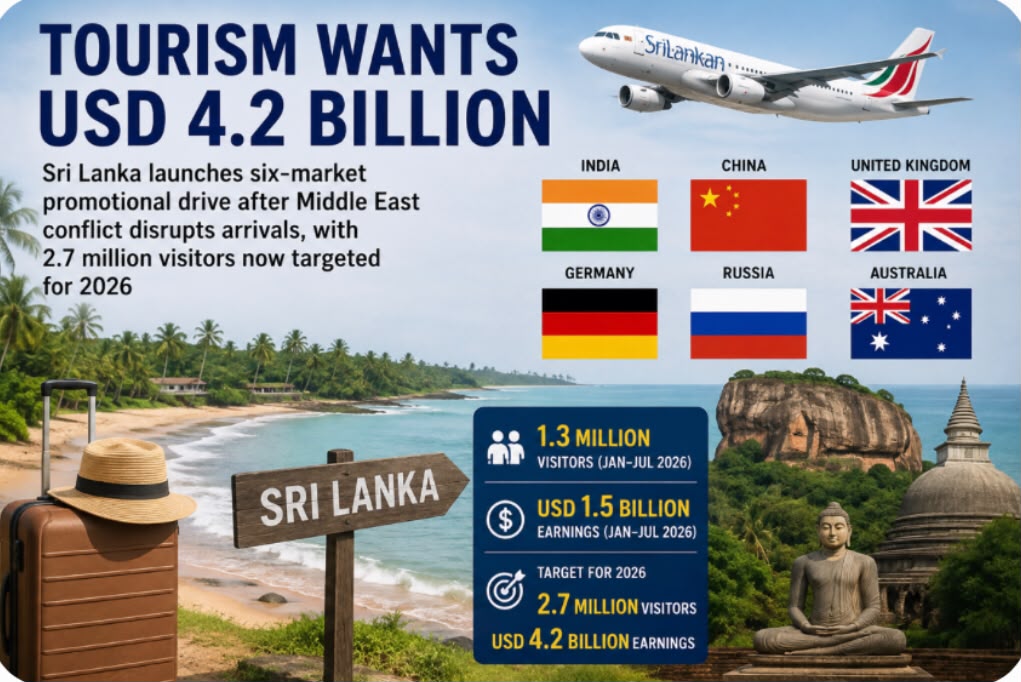
Sri Lanka launches six-market promotional drive after Middle East conflict disrupts arrivals, with 2.7 million visitors now targeted for 2026
COLOMBO – Sri Lanka has launched a new tourism promotion campaign across six major overseas markets as the country attempts to earn USD 4.2 billion from visitors this year and recover momentum lost when the Middle East conflict disrupted international aviation and travel earlier in 2026.
The campaign will concentrate on India, China, Britain, Germany, Russia and Australia, markets considered capable of delivering significant numbers of visitors during the remainder of the year. Sri Lanka received approximately 1.3 million tourists during the first seven months of 2026 and generated around USD 1.5 billion in tourism earnings, but the original annual target of three million arrivals has been revised to approximately 2.7 million.
Submit Your Press Release
Get your company news, announcements, launches, appointments and events in front of a wider audience.


The downward revision followed a sharp disruption during March and April, when arrivals fell by around 20 per cent as conflict in the Middle East affected aviation and international travel. The episode demonstrated again how quickly Sri Lanka’s tourism industry can be affected by geopolitical events occurring far beyond the island, particularly when air routes, fuel prices and traveller confidence are disturbed.
Tourism remains one of the fastest ways for Sri Lanka to generate foreign currency, making the sector particularly important as the Government attempts to increase official reserves towards USD 9 billion by the end of the year. Every additional visitor contributes directly or indirectly through hotels, restaurants, transport, attractions, retail activity and the wider service economy. The more difficult question is whether Sri Lanka is extracting sufficient value from the visitors it already attracts. Arrival numbers are politically attractive, but tourism earnings per visitor, average length of stay and expenditure outside the major hotel sector provide a better indication of what the industry contributes to the economy.
Sri Lanka possesses an unusually diverse tourism product within a comparatively small geographical area, combining beaches, wildlife, mountains, archaeological sites and a substantial cultural offering. Its weakness has repeatedly been execution, with promotional campaigns delayed while visa policy, airport capacity, transport and regulation have periodically created unnecessary difficulties for an industry competing against highly organised destinations across Asia.
A wider international tourism promotion campaign is now expected in 2027 after years of discussion and delay. In the meantime, the six-market initiative will have to carry much of the immediate burden of rebuilding momentum ahead of the important winter season.
The target of USD 4.2 billion is achievable only if Sri Lanka treats tourism as part of its foreign-exchange strategy rather than merely as an industry serving hotels. The country’s natural attractions have already done much of the marketing work; the remaining challenge is ensuring that government policy makes it as easy as possible for visitors to arrive, spend and return.