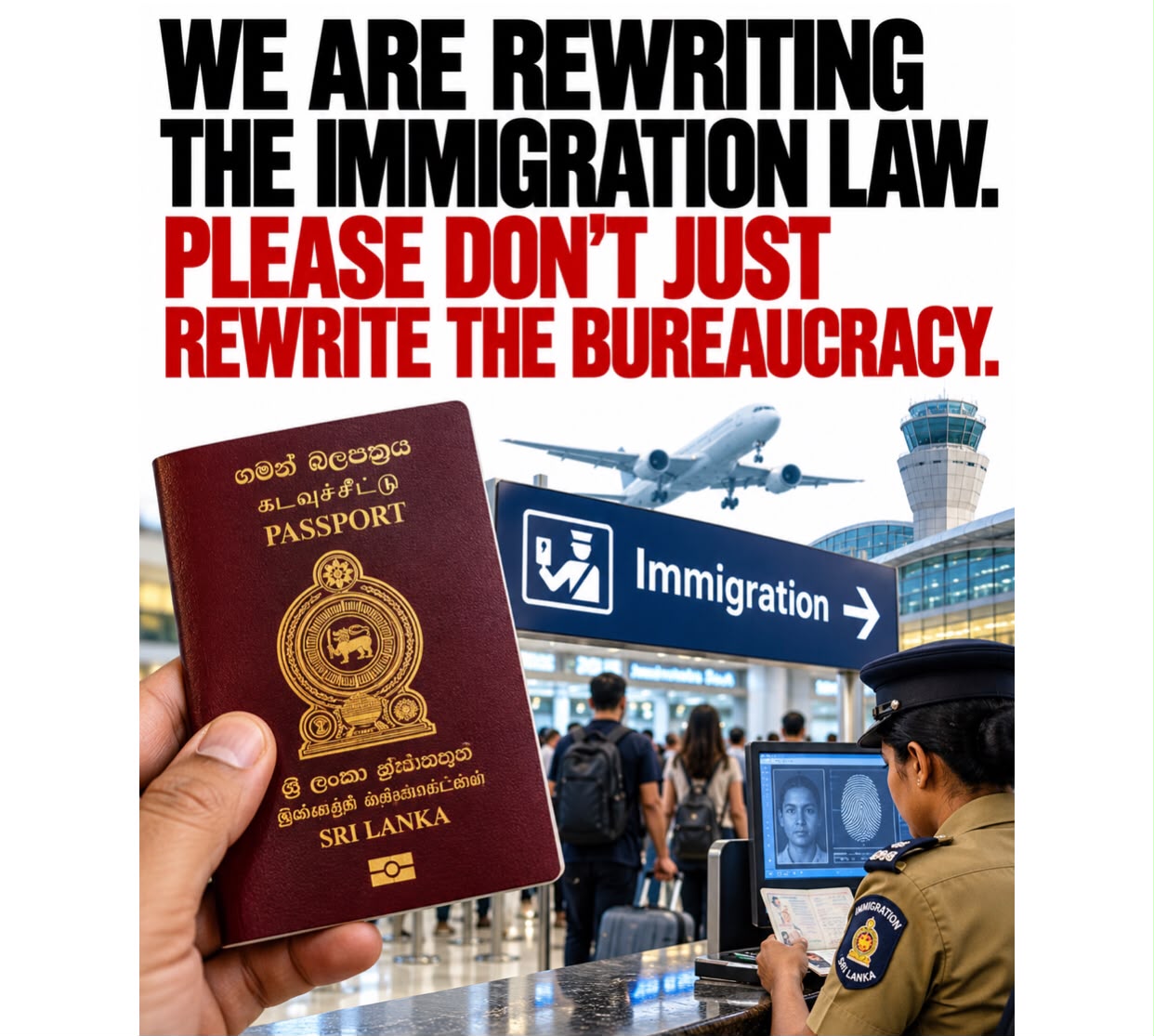
Sri Lanka needs a modern immigration law. The present framework belongs largely to another age, while tourism, investment, biometric identification, human trafficking and international crime have transformed the movement of people across borders. A new law is therefore overdue. Whether it produces a new immigration service is another matter entirely.
The new Immigration Bill before Parliament presents Sri Lanka with an opportunity considerably larger than replacing ageing legislation. It provides the Government with the chance to rethink how a country dependent on tourism, hungry for investment and increasingly connected to the world manages the people entering and leaving its borders.
The principle is simple enough. Legitimate travellers should find Sri Lanka easy to enter, while people attempting to misuse its borders should find it considerably more difficult. Achieving both objectives simultaneously is where legislation, technology and competent administration have to meet.
Submit Your Press Release
Get your company news, announcements, launches, appointments and events in front of a wider audience.


Sri Lanka’s recent experience with visas provides a useful warning. We have managed to turn what should be one of the simplest interactions between a visitor and the State into arguments over online systems, charges, contractors, free visas, implementation dates and procurement. A country competing with Thailand, Malaysia, Vietnam, Indonesia and the Maldives for travellers cannot afford to make uncertainty part of the arrival experience.
Tourism is an export consumed inside Sri Lanka. Every unnecessary complication placed between a potential visitor and an aircraft seat therefore has an economic cost, even though it may never appear as a line in the national accounts.
The same applies to investors and professionals. A foreign executive considering a regional operation does not need a welcoming speech followed by a bewildering visa process. An investor should be able to understand what category applies, what it costs, how long approval takes and what activities it permits.
At the same time, immigration is not simply a customer service operation. Sri Lanka must know who enters the country, under what identity and for what purpose. It must be able to identify overstayers, illegal workers, trafficking networks and people attempting to exploit weaknesses in the border system.
That makes the proposed modernisation, including greater use of biometric identification, potentially valuable. Properly implemented biometrics can make passports harder to forge, identity fraud more difficult and airport processing faster. They can also create an extraordinarily valuable database of personal information held by the State.
That part deserves considerably more parliamentary attention than the attraction of new technology itself. The question is not simply whether Sri Lanka can collect biometric information, but who controls it, who can access it, how long it is retained, whether it can be shared with other agencies and what happens when the information is wrong.
A digital mistake can be more efficient than a paper mistake and considerably harder to escape. If a traveller is incorrectly flagged by a computer system, there must be a practical mechanism for correcting the record rather than an endless journey between government counters while each official insists that the computer cannot be wrong.
The same scrutiny should apply to discretionary powers contained in the new framework. Immigration officials necessarily require authority to refuse entry in appropriate circumstances and the State must be able to remove people who have no lawful entitlement to remain. Those powers should be clear, reviewable and sufficiently defined that administrative discretion does not become arbitrary power.
Sri Lanka has repeatedly learned what happens when legislation drafted to address a legitimate problem contains powers broad enough to be used for something else later. Parliament should therefore examine the Immigration Bill not merely for what the present Government says it intends to do with it, but for what any future Government could legally do with the powers Parliament is about to create.
There is a much more positive possibility here as well. Sri Lanka could build an immigration system in which most legitimate travellers complete the administrative process before arriving, airport formalities take minutes rather than becoming another queue and immigration officers concentrate their attention on genuine risk rather than paperwork.
That would help tourism, business and national security simultaneously. It would also be one of those rare government reforms whose success could be measured almost immediately by the person standing in front of the immigration counter.
Passing a modern law is the easy part.
The real achievement would be making immigration work so efficiently that most people barely notice it.
Sri Lanka needs the new law. It needs the new service even more.