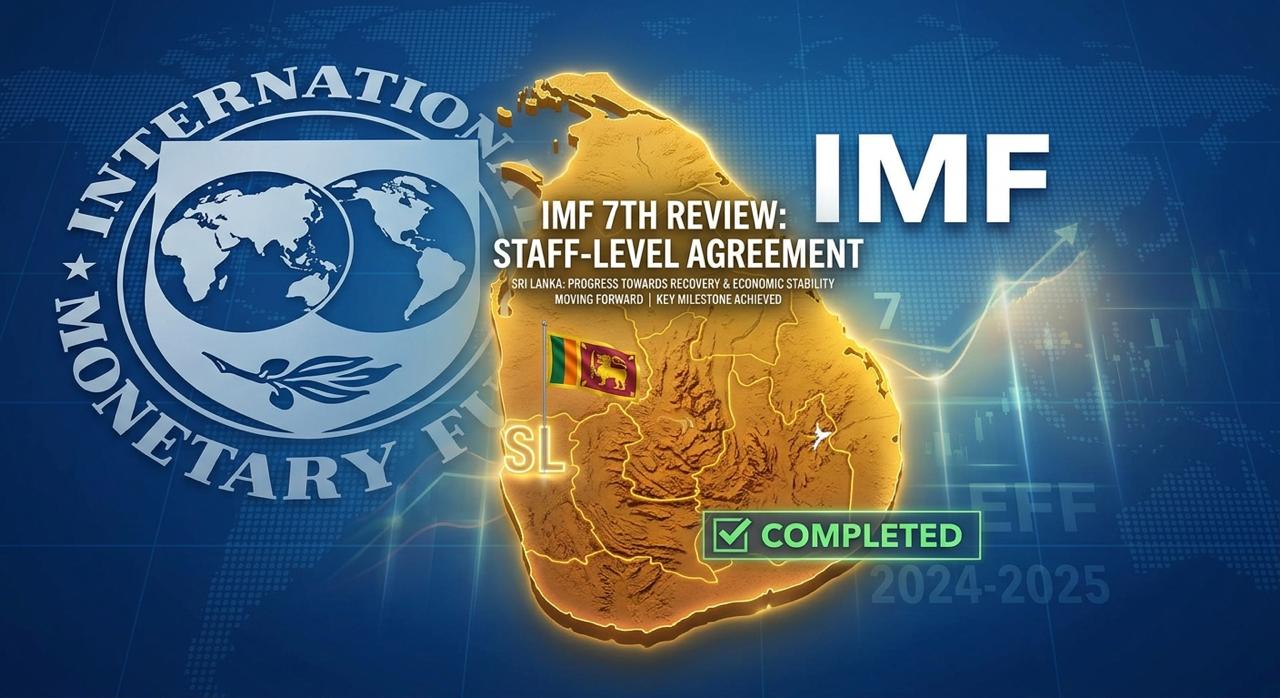
Sri Lanka has reached staff-level agreement on the seventh review of its IMF programme, another important marker in a recovery that has travelled a considerable distance since default. But completing reviews is not the final purpose of economic policy. The real test is whether Sri Lanka can emerge from the programme without recreating the conditions that forced it into one.
Sri Lanka and the International Monetary Fund have reached staff-level agreement on the seventh review under the Extended Fund Facility, moving the country another stage through the programme that became unavoidable after the economic collapse of 2022. Subject to the remaining approvals and conditions, another tranche of financing can follow and the Government can legitimately point to continued progress in maintaining the programme.
That matters because credibility matters. A country that defaulted on its sovereign debt, exhausted usable foreign exchange and eventually became unable to guarantee basic imports cannot rebuild international confidence merely by announcing that things are better. It has to demonstrate over time that fiscal policy, monetary policy, debt management and government finances have changed sufficiently to prevent the same disaster happening again.
Submit Your Press Release
Get your company news, announcements, launches, appointments and events in front of a wider audience.


Sri Lanka has made substantial progress. Revenue has improved, debt restructuring has moved forward, foreign exchange availability is no longer the daily national emergency it once was and economic growth has returned. The queues and shortages that defined the worst months of the crisis have largely disappeared, which should not be casually dismissed simply because the political argument has moved on.
The danger is that Sri Lanka begins treating successful IMF reviews as the objective rather than the instrument. Passing the seventh review is useful, but an economy does not exist to pass IMF reviews any more than a patient exists to produce satisfactory medical reports. The programme is supposed to help restore an economy capable eventually of functioning without extraordinary external supervision.
That is where the harder questions begin.
Sri Lanka has increased taxes because government revenue had collapsed to levels that were plainly unsustainable. It has adjusted electricity prices, restructured state enterprises, tightened public finances and imposed considerable costs on households already weakened by the economic crisis. Much of that adjustment was unavoidable, but austerity and reform are not interchangeable words.
A Government can balance accounts by collecting more from an economy. The greater achievement is to make the economy larger so that the same tax burden produces more revenue without continually extracting a greater share from households and businesses.
That requires growth of a different quality.
Sri Lanka needs exports capable of earning substantially more foreign currency. It needs investment that creates productive capacity rather than simply buying existing assets. It needs companies prepared to manufacture here, regional headquarters prepared to locate here and entrepreneurs able to expand without spending an unreasonable amount of their time negotiating with the State.
This is where the Government’s economic performance should increasingly be judged. The first stage of recovery was necessarily about stabilisation. The second must be about expansion, because a permanently stabilised low-growth economy with high taxation and widespread poverty is not an economic success.
There is also the uncomfortable question of what happens after the IMF programme.
Sri Lanka has been here before. We have entered IMF programmes, accepted reforms, completed some of them, abandoned others and eventually returned when the underlying weaknesses reappeared. The cycle itself should tell us that the IMF has never been the central Sri Lankan problem.
We have been.
Governments spent money they did not have, subsidised things they could not afford, protected inefficient institutions, resisted sensible taxation when it was politically inconvenient, borrowed heavily and frequently treated foreign exchange as though it would somehow always arrive. Political parties then promised voters benefits without adequately explaining who would pay for them.
The NPP came to power promising a different political culture. It now has an opportunity to demonstrate a different economic culture as well, one in which fiscal responsibility survives after the IMF officials have packed their files and left Colombo.
That will require political courage because the reforms that prevent crises are rarely popular when there is no crisis visible. Maintaining sensible electricity pricing is harder when the lights are already on. Maintaining adequate taxation is harder when reserves have recovered. Refusing unaffordable election promises becomes harder when the next election approaches.
Those are precisely the moments when discipline matters most.
The seventh review is therefore good news, but it should not become another ceremonial milestone accompanied by declarations that Sri Lanka has turned the corner. We have turned several corners since 2022 and discovered that there was another one immediately ahead.
The destination is not the next IMF tranche. It is the day Sri Lanka no longer needs one.