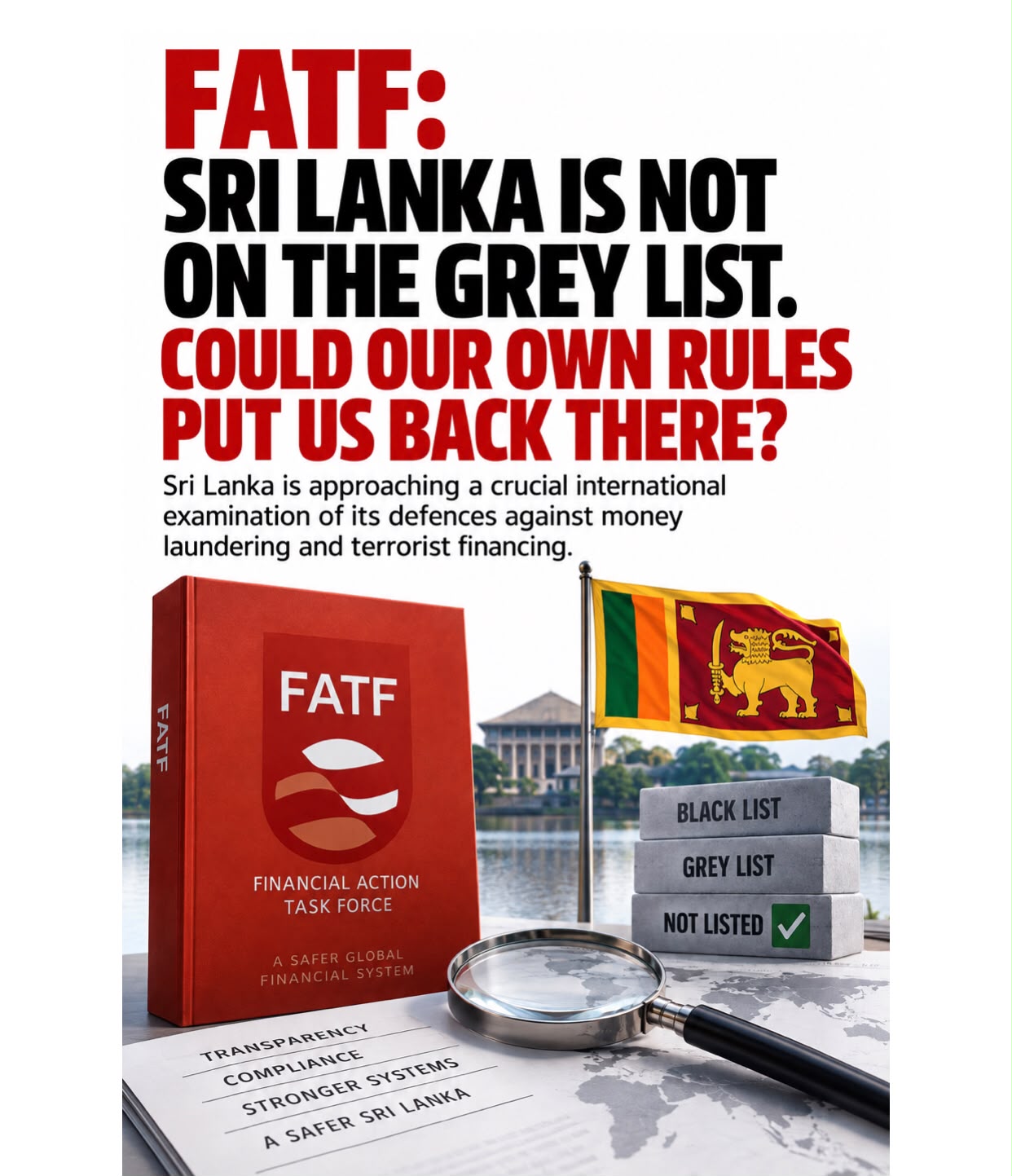
Sri Lanka is approaching a crucial international examination of its defences against money laundering and terrorist financing. The country wants to demonstrate that it has learned the lessons of its previous grey-listing. But the United Nations is warning of a curious danger: in trying too hard to satisfy FATF, Sri Lanka could impose sweeping restrictions that FATF itself does not require.
Sri Lanka is preparing for one of the more important examinations of its financial system since the economic crisis, and this one will not be decided by the size of the country’s foreign reserves, the Budget deficit or the exchange rate. It will examine whether Sri Lanka can demonstrate that its systems for combating money laundering and terrorist financing actually work.
The country’s third Mutual Evaluation is being conducted through the Asia-Pacific Group, the regional body associated with the Financial Action Task Force. The assessment looks not simply at whether Sri Lanka has laws and regulations on the books, but whether the country can demonstrate effective implementation. Sri Lanka has been through this before and knows the consequences of getting it wrong.
Submit Your Press Release
Get your company news, announcements, launches, appointments and events in front of a wider audience.


Sri Lanka was previously placed under increased monitoring commonly known as the FATF grey list before eventually working its way out. It is not presently on that list. The objective now must surely be to stay that way.
Yet an intriguing argument has emerged over precisely how Sri Lanka is preparing for the examination. United Nations Resident Coordinator Marc-André Franche has warned that anti-money laundering and counter-terrorism financing requirements should not become justification for blanket restrictions on Sri Lanka’s civil society organisations. His argument is particularly important because it challenges the assumption that tougher regulation automatically means better compliance.
FATF’s approach to non-profit organisations has evolved significantly. Its Recommendation 8 recognises that terrorist organisations can attempt to exploit non-profit organisations, but the revised standard rejects treating the entire non-profit sector as inherently high-risk. It calls instead for measures that are focused, proportionate and risk-based, directed at organisations and activities where identifiable vulnerabilities exist. Put simply, find the risk and mitigate it rather than treating everybody as a risk.
That distinction matters because Sri Lanka’s determination to avoid another adverse FATF outcome is entirely understandable. A country emerging from economic collapse hardly needs questions raised once again about the integrity of its financial system. International banks, investors and businesses pay attention to these assessments, and the reputational consequences can travel considerably further than the language of an evaluation report.
The Central Bank itself has been warning that legislation alone will not be enough. Central Bank Governor Dr Nandalal Weerasinghe recently highlighted what he described as an extraordinary weakness in the system: the legal profession had submitted only two Suspicious Transaction Reports during the period he identified from 2020 to 2026. Lawyers, notaries and other designated professions have obligations within the anti-money laundering system because financial crime does not occur exclusively inside banks.
That illustrates the real challenge rather neatly. Sri Lanka can pass laws, amend Acts, create offences, increase investigative powers and produce regulations. The international examination, however, is increasingly concerned with whether those systems actually identify suspicious money, investigate it effectively and produce meaningful results.
There is therefore a danger in confusing visible regulatory toughness with effective regulation. Civil society organisations receiving legitimate foreign funding should not encounter arbitrary banking restrictions merely because foreign money is involved. Equally, describing oneself as a charity or non-profit cannot provide immunity from legitimate scrutiny where evidence indicates an actual terrorist-financing risk. Both propositions can be true simultaneously.
Sri Lanka strengthened its anti-money laundering and terrorist-financing legislation this year, including amendments to the Prevention of Money Laundering Act, the Financial Transactions Reporting Act and legislation dealing with the suppression of terrorist financing. Those measures have strengthened the legal architecture available to investigators and regulators, but with greater power comes an equally important obligation: proportionality.
A system capable of freezing assets, examining financial transactions and restricting access to banking possesses powers that can profoundly affect individuals and organisations long before anybody is convicted of an offence. Those powers therefore require safeguards, transparent procedures and a meaningful ability to challenge decisions. FATF itself has made an important distinction: its standards are not intended to encourage financial institutions simply to cut off entire categories of customers because they are considered inconvenient or potentially risky. The objective is to understand risk and manage it.
That principle becomes particularly important when dealing with civil society. If an organisation presents a genuine terrorist-financing risk, investigate it, follow the money, require explanations and apply the law. Freeze assets where the legal threshold is met and prosecute where the evidence supports prosecution. That is very different from constructing a regulatory system in which an entire sector is effectively required to prove its innocence simply because some organisations may be vulnerable to abuse.
This is not an argument for weaker counter-terrorist-financing or anti-money-laundering laws. Sri Lanka has ample experience demonstrating why strong ones are necessary. It is an argument for intelligent regulation that concentrates the State’s considerable powers where evidence and identifiable risk justify their use.
There lies the irony. Sri Lanka is understandably anxious to demonstrate to international assessors that it has built a serious system capable of combating money laundering and terrorist financing. But if that determination produces indiscriminate restrictions, excessive compliance burdens or the financial exclusion of legitimate organisations, the country risks moving away from the very risk-based philosophy FATF now advocates.
The question therefore should not be how many organisations Sri Lanka can regulate, but whether Sri Lanka can identify the organisations, transactions and individuals that actually present a risk and act effectively against them. That is a much harder test, but it is also a considerably more meaningful one.
The Mutual Evaluation ahead is therefore about considerably more than satisfying international assessors. It will test whether Sri Lanka has built institutions capable of distinguishing genuine financial danger from perfectly legitimate financial activity. That requires strong laws, competent regulators, banks willing to ask difficult questions and professions outside the banking system prepared to fulfil their reporting obligations. It also requires judgement.
Sri Lanka has already experienced the reputational and financial consequences associated with FATF increased monitoring. Nobody should want to return there, but fear of the grey list cannot itself become the justification for indiscriminate regulation.
The real measure of a mature financial regulatory system is not how much power it possesses. It is whether that power is directed at the right people, for the right reasons, on the basis of evidence and identifiable risk. Sri Lanka does not need weaker regulation. It needs better regulation.