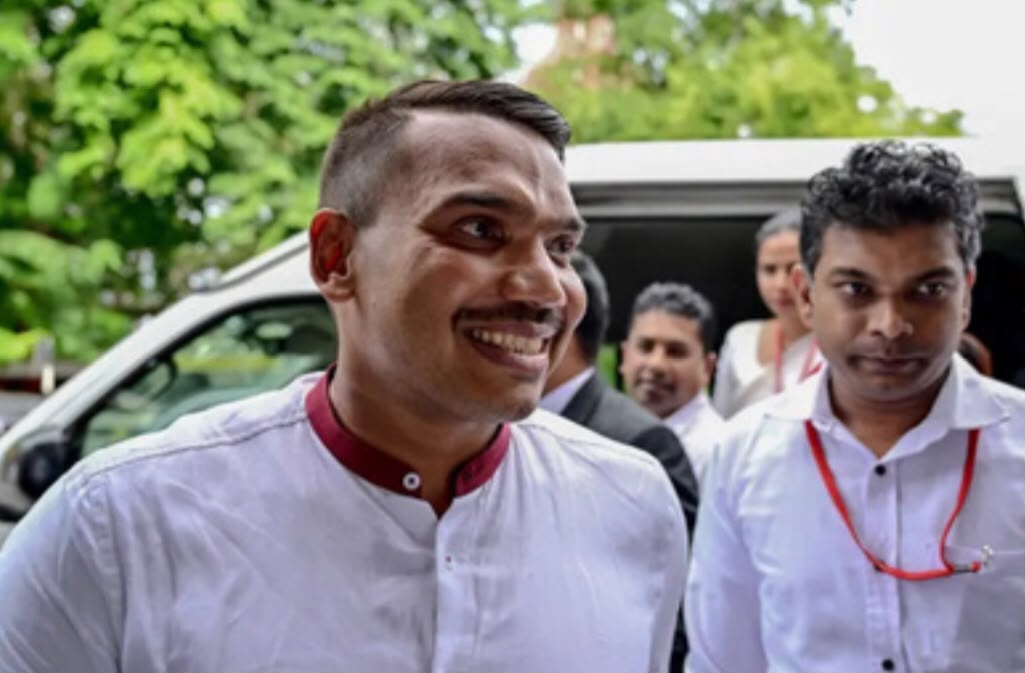
Namal Rajapaksa entered this week already in remand over an alleged Rs 100 million Airbus-linked bribe. He has now also been named a suspect in a separate money-laundering investigation arising from the controversial SriLankan Airlines aircraft procurement and ordered to remain in remand until September 23. Two proceedings, one enormous aircraft deal and allegations that will ultimately have to survive something considerably more demanding than a press conference: a courtroom.
The legal difficulties confronting Namal Rajapaksa have moved into substantially more serious territory. The SLPP National Organiser and Hambantota District MP was already in remand custody following his September 4 arrest by the Commission to Investigate Allegations of Bribery or Corruption over allegations that he received approximately Rs 100 million connected with the controversial SriLankan Airlines Airbus procurement.
There is now a second legal track.
Submit Your Press Release
Get your company news, announcements, launches, appointments and events in front of a wider audience.


Rajapaksa has been named as a suspect in a separate money-laundering investigation being pursued by the Criminal Investigation Department arising from alleged financial irregularities surrounding the same aircraft procurement. He was produced before the Colombo Fort Magistrate’s Court this week and ordered to remain in remand until September 23, when the court is expected to rule on his application for bail.
The distinction between the two proceedings is important.
The CIABOC investigation concerns allegations that Rajapaksa received money connected with the Airbus transaction. The second proceeding concerns alleged money laundering and is being pursued through the CID following instructions from the Attorney General.
They arise from the same extraordinary Airbus affair, but they are not simply two descriptions of the same case.
Prosecutors have told court that evidence obtained during the investigation includes material originating from Airbus and overseas financial transactions. In the bribery proceeding, investigators have alleged that approximately €1.45 million was transferred into a Singapore account connected with Biz Solutions Inc and that US$800,000 subsequently moved to an account belonging to Sabre Vision Holdings Ltd.
Investigators allege that money was subsequently provided to Rajapaksa in Sri Lanka in a series of payments amounting to approximately Rs 100 million. The prosecution has also referred to statements from individuals connected with Airbus and documentary material obtained during the investigation.
These remain allegations.
Rajapaksa has not been convicted of either bribery or money laundering, and remand custody must never be confused with guilt. His lawyers are entitled to challenge the evidence, question the alleged financial trail and require the prosecution to prove every necessary element of any offence eventually charged.
That is precisely why what happens next matters considerably more than the political excitement surrounding an arrest.
Sri Lanka has seen spectacular corruption allegations before. It has seen politicians summoned, questioned, arrested and photographed entering court. What it has seen considerably less frequently are complex financial investigations carried through methodically to judgments capable of surviving appeal.
The Attorney General’s Department has indicated that indictments connected with the Airbus investigation will be filed without delay. If that happens, the case will move beyond investigation and remand into the considerably more consequential territory of prosecution.
The political temperature surrounding the proceedings is already high. The SLPP has portrayed the action against its National Organiser as politically motivated, while the Government insists that law-enforcement agencies are being permitted to pursue investigations without regard to political status.
Neither proposition decides the case.
Evidence does.
The Government must therefore resist the temptation to treat the arrest of a Rajapaksa as proof of its anti-corruption credentials. The Opposition must equally resist the assumption that proceedings against a political figure automatically constitute persecution.
If investigators possess the evidence they say they possess, put it before the appropriate court. If the defence can dismantle it, it must be permitted to do so.
Namal Rajapaksa now faces two legal fronts arising from one of the most controversial procurement episodes in SriLankan Airlines’ history.
The important question is no longer whether a Rajapaksa can be arrested.
It is whether the evidence can withstand a trial.