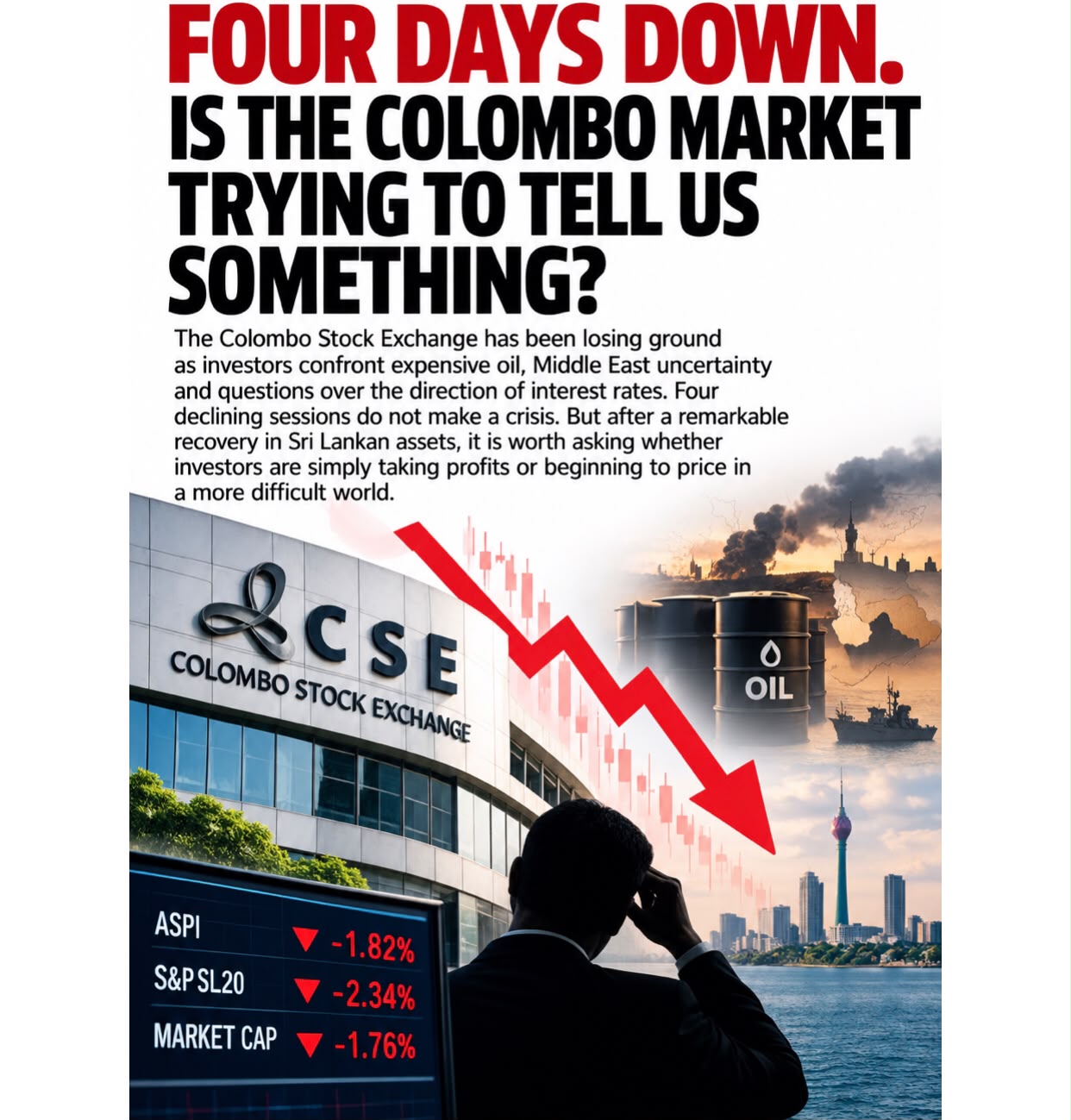
The Colombo Stock Exchange has been losing ground as investors confront expensive oil, Middle East uncertainty and questions over the direction of interest rates. Four declining sessions do not make a crisis. But after a remarkable recovery in Sri Lankan assets, it is worth asking whether investors are simply taking profits or beginning to price in a more difficult world.
The Colombo stock market has suddenly lost some of its swagger.
After a powerful period for Sri Lankan equities, the All Share Price Index has recorded a succession of weaker sessions, while market turnover has also shown signs of losing momentum.
Submit Your Press Release
Get your company news, announcements, launches, appointments and events in front of a wider audience.


Four days are not enough to declare a trend, still less a crisis.
Stock markets rise and fall for reasons that can have little to do with the underlying economy. Investors take profits, institutions rebalance portfolios and individual large transactions can move an index in ways that appear considerably more dramatic than they really are.
Nevertheless, the timing deserves attention.
Sri Lanka’s financial markets are confronting an external environment that has become markedly less comfortable. Oil has climbed above US$100 a barrel as shipping through the Strait of Hormuz contracts and attacks on regional energy infrastructure increase uncertainty over supplies.
For an oil-importing economy, that matters.
Higher petroleum prices can place pressure on inflation, the trade account and the rupee. They can also affect corporate profitability through electricity, transport, manufacturing and logistics costs.
At the same time, investors must calculate what the energy shock means for interest rates.
If higher imported energy costs begin feeding materially into domestic inflation, the Central Bank has less room to make money cheaper. Higher interest rates, or even the expectation that rates may remain elevated for longer, can make fixed-income investments relatively more attractive than shares.
Foreign investors have another calculation.
They do not merely consider whether a Sri Lankan share or Government security will rise in rupee terms. They must also consider what those rupees will be worth when converted back into dollars.
The rupee has already weakened this year.
None of this means investors are abandoning Sri Lanka.
Indeed, foreign money has been returning strongly to rupee Government securities, with thirteen consecutive weeks of net purchases recently recorded. Sri Lankan debt is also attracting renewed international attention as the country returns to global investment benchmarks.
That makes the contrast particularly interesting.
Money may not be leaving Sri Lanka. It may simply be moving around inside the opportunity Sri Lanka now represents.
The stock market itself has travelled an enormous distance from the pessimism surrounding the economic collapse. Investors who bought into that recovery have enjoyed substantial gains, making periods of profit-taking entirely unsurprising.
The danger is therefore not that the ASPI has fallen for several sessions.
The danger would be assuming that because Sri Lankan assets recovered strongly, they can only continue moving in one direction.
Markets are useful precisely because they are unsentimental.
They do not vote. They do not attend political rallies. They do not applaud Government announcements.
They continuously place a price on confidence.
Four difficult days do not tell us that confidence has disappeared.
They are simply a useful reminder that it must continually be earned.