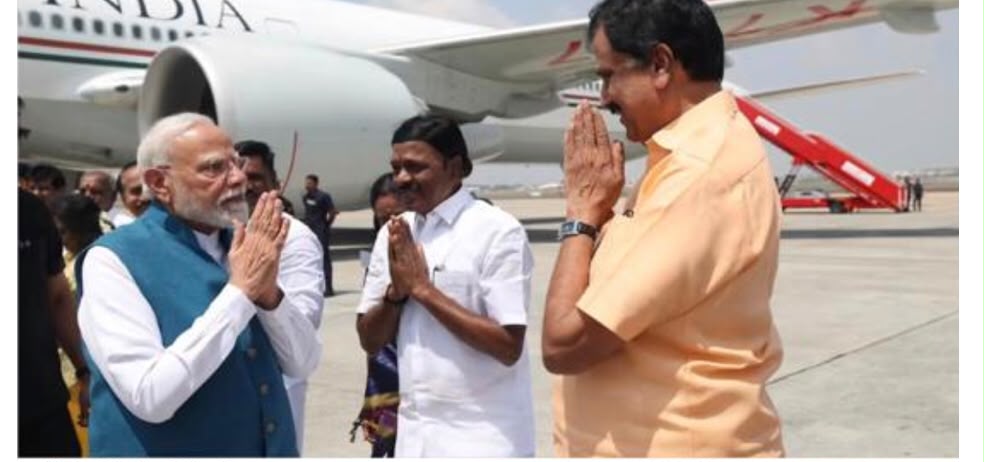
Indian Prime Minister Narendra Modi visited Chennai on Sunday, 11 October, to inaugurate and launch development projects worth more than ₹13,000 crore. Among those photographed welcoming him at the airport was Malepati Chakravarthy, Vice President of the Bharatiya Janata Party in Tamil Nadu, who has known Modi personally for at least 16 years. The visit underlined the importance of infrastructure investment in one of India’s most economically significant states and offered a reminder of the scale of development taking place immediately across the Palk Strait.
Indian Prime Minister Narendra Modi arrived in Chennai on Sunday for a programme involving the inauguration and commencement of infrastructure and development projects valued at more than ₹13,000 crore. The visit brought together central government investment, Tamil Nadu’s regional political leadership and an ambitious programme intended to strengthen transportation, maritime infrastructure, education and industrial connectivity.
Modi was received at Chennai airport by Tamil Nadu Chief Minister C. Joseph Vijay and other political representatives, including senior members of the Bharatiya Janata Party.
Submit Your Press Release
Get your company news, announcements, launches, appointments and events in front of a wider audience.


Among those photographed greeting the Prime Minister was Malepati Chakravarthy, Vice President of the BJP in Tamil Nadu. Chakravarthy has personally known Modi for at least 16 years.
Photographs obtained by NEWSLINE show Chakravarthy greeting the Prime Minister during the airport reception. The images provide a glimpse of the longstanding personal relationships that accompany the formal structures of political leadership.
The visit itself was substantially concerned with economic development.
Modi inaugurated the Poonamallee-Vadapalani section of Phase II of the Chennai Metro Rail Project, an investment valued at approximately ₹4,900 crore. The new section forms part of a wider effort to improve urban mobility in a metropolitan area that has experienced substantial economic and population growth.
The Prime Minister also participated in a Metro journey with the Tamil Nadu Chief Minister, an occasion that carried significance beyond the opening of another railway connection.
India’s federal political system frequently brings together governments controlled by different political parties. Infrastructure investment requires cooperation between national and state authorities, even when those authorities compete vigorously in elections.
The Chennai programme also included railway improvements valued at more than ₹750 crore, the redevelopment of railway stations and projects intended to strengthen road and maritime connectivity.
Port development formed an important part of the announcements.
Chennai and other ports in Tamil Nadu are central to India’s manufacturing, logistics and international trading networks. Improvements in cargo-handling capacity, storage facilities and associated infrastructure are intended to support industrial expansion and more efficient movement of goods.
Modi also visited the Indian Institute of Technology Madras, where he inaugurated the Sudha Gopalakrishnan Brain Centre and highlighted research intended to advance scientific understanding of the human brain.
The programme included a project to develop detailed three-dimensional maps of more than 100 human brains at cellular resolution, covering different stages of human development.
The inclusion of advanced scientific research alongside transport and industrial infrastructure illustrates the breadth of India’s development ambitions.
For Sri Lanka, developments in Tamil Nadu deserve particular attention.
The Indian state lies immediately across the Palk Strait and maintains longstanding historical, cultural, commercial and political relationships with Sri Lanka.
Tamil Nadu is also an important manufacturing centre, with substantial activity in automobiles, electronics, textiles, engineering and technology services.
Its infrastructure investments therefore have implications for regional trade, supply chains and economic competition.
Sri Lanka has repeatedly identified its geographical position as a potential advantage in attracting investment and developing logistics services. That advantage must be considered against the continuing expansion of infrastructure and industrial capacity in neighbouring Indian states.
Proximity to a rapidly developing economy can create opportunities, but it does not automatically produce economic benefits.
Those benefits depend upon competitiveness, efficient administration, reliable infrastructure and the ability to establish productive commercial relationships.
The visit also illustrated the political importance of Tamil Nadu within India’s federal system.
The BJP continues to maintain and develop its organisation in a state with a distinctive political history and strong regional parties. The presence of senior state party representatives at the airport reflected the political dimension of the Prime Minister’s visit, alongside the official programme.
India continues to expand its infrastructure, industrial capacity and research institutions through programmes involving both national and state authorities.
Sri Lanka, meanwhile, faces the challenge of translating economic stabilisation into sustained investment and productive growth.
The comparison should not ignore the enormous differences in population, resources and economic scale between the two countries. Nevertheless, the importance of consistent infrastructure planning and effective implementation applies to both.
Be that as it may, while India continues to announce new railway lines, port facilities and scientific research centres, Sri Lanka would do well to ensure that its own development ambitions advance beyond announcements and ceremonial foundation stones.