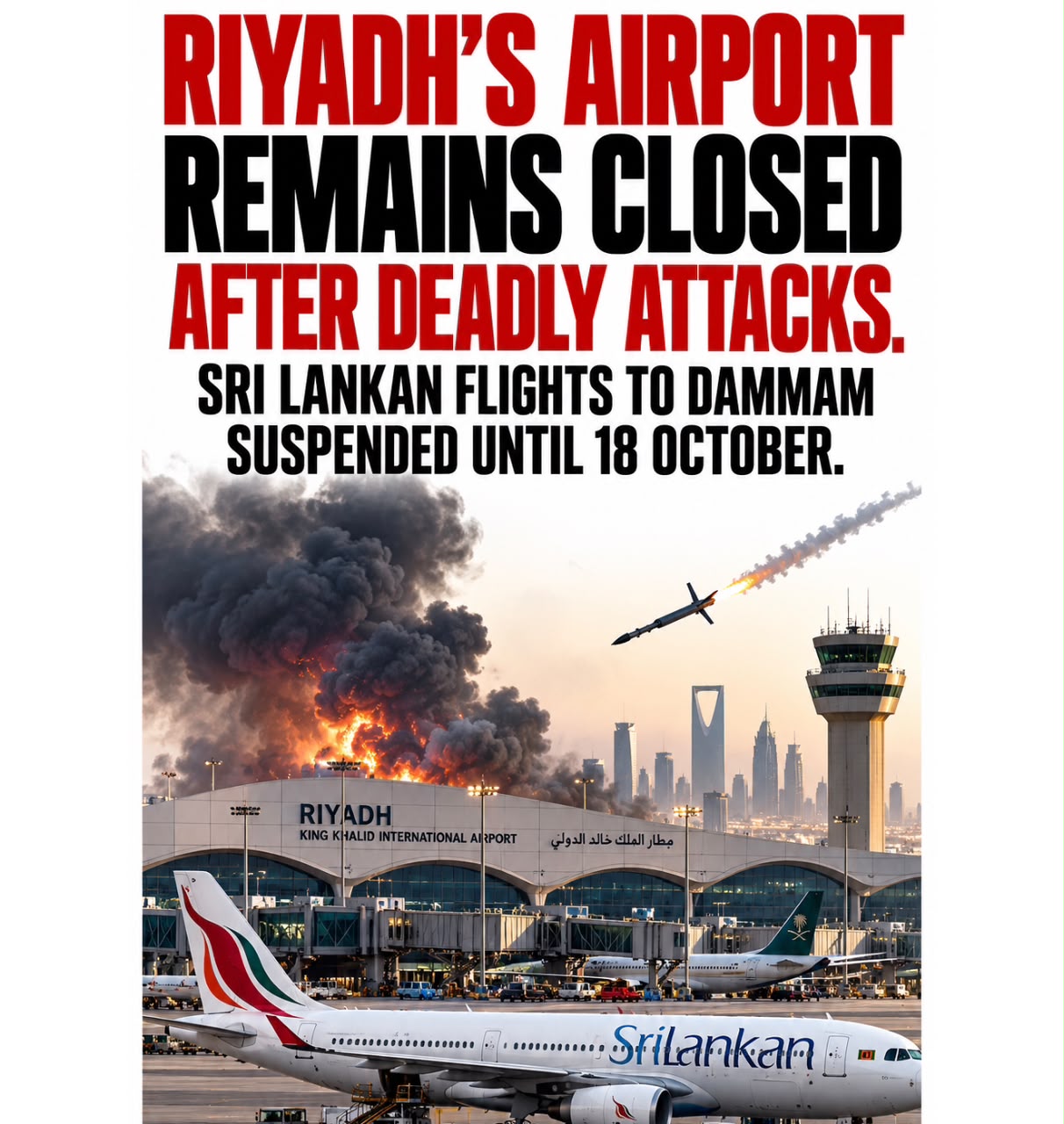
Saudi Arabia’s aviation system is confronting one of its most serious security disruptions in years following deadly missile and drone attacks attributed to Yemen’s Iran-aligned Houthi movement. Riyadh’s principal airport remains closed, international airlines have suspended services and SriLankan Airlines has announced the suspension of flights between Colombo and Dammam until 18 October. The immediate question for Colombo is how the escalating crisis affects Sri Lankan citizens living and working in the kingdom.
Saudi Arabia entered another day of serious security disruption on Monday as authorities extended the closure of King Khalid International Airport in Riyadh following a series of deadly missile and drone attacks. The strikes have caused substantial casualties, disrupted international aviation and exposed the vulnerability of civilian infrastructure in a country central to global energy markets.
Saturday’s attack on Riyadh airport killed 13 people and injured more than 300, according to international reporting. A subsequent attack on Sunday reportedly killed another person and injured 11 others. The scale of the casualties and the repeated targeting of aviation infrastructure have raised concerns about the kingdom’s ability to maintain normal civilian operations while confronting the Houthi threat.
Submit Your Press Release
Get your company news, announcements, launches, appointments and events in front of a wider audience.


The disruption has extended beyond Riyadh. Dammam, the principal city of Saudi Arabia’s Eastern Province, has also experienced attacks affecting aviation infrastructure. The province is particularly important because of its proximity to the kingdom’s principal petroleum production and export facilities.
International airlines have suspended services, while aviation authorities and foreign governments have issued security advisories. The consequences extend well beyond passengers stranded at airports. Commercial operations, international conferences, investment activity and business travel are all being affected.
The crisis is especially significant for Sri Lanka because of its economic and human connections with Saudi Arabia.
On Monday, SriLankan Airlines announced that all flights between Colombo and Dammam would remain suspended until 18 October because of the prevailing security situation. The airline said services would resume when conditions were assessed as suitable for commercial operations.
The announcement provides a concrete indication that the consequences of the Saudi crisis are already affecting Sri Lankan transport connections.
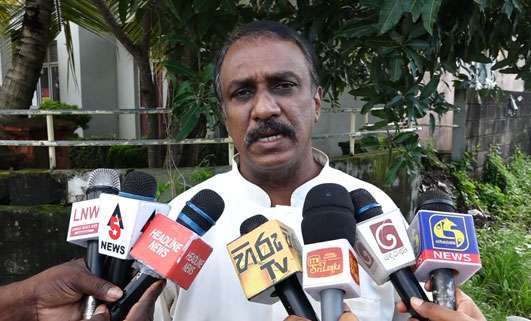
The Ministry of Foreign Affairs issued a statement on 9 October condemning attacks on civilian airports in Saudi Arabia. The Sri Lankan Embassy in Riyadh also published an important announcement for Sri Lankan nationals in the kingdom on the same date.
The existence of that Embassy announcement is significant and should be distinguished from the absence of a newly verified statement on Monday. NEWSLINE has not independently established whether the mission has subsequently issued additional instructions or whether any Sri Lankan nationals have been injured in the attacks.
The Ministry and Embassy should clarify the position, including the arrangements available to Sri Lankan workers whose employment, accommodation or travel plans may be affected.
Particular attention should be given to workers in vulnerable employment arrangements, including domestic workers who may have limited access to independent transport or alternative accommodation.
There is also a wider economic dimension. Saudi Arabia is one of the world’s most important petroleum producers, and threats to its infrastructure can influence energy markets even when production facilities remain operational.
For Sri Lanka, already burdened by the cost of imported fuel, any prolonged disruption affecting oil supplies, shipping or insurance would create additional pressure on an economy still recovering from its recent financial crisis.
The immediate responsibility of the Saudi authorities is to protect civilian life and infrastructure. The responsibility of Sri Lanka’s Government is to ensure that its citizens are informed, supported and able to obtain assistance when necessary.
The Foreign Ministry’s condemnation of attacks on civilian infrastructure is an appropriate diplomatic response. But diplomatic statements and consular protection serve different purposes, and both matter.
The kingdom’s security crisis also presents a difficult strategic question for Crown Prince Mohammed bin Salman. Military retaliation could carry the danger of wider escalation, while restraint may not prevent further attacks. Saudi Arabia’s economic ambitions depend heavily upon international confidence in its stability.
That confidence is difficult to sustain when a major international airport is repeatedly attacked and commercial aircraft cannot operate normally.
For Sri Lanka, the priority must remain the safety of its citizens and the protection of essential transport and economic connections.
Be that as it may, the immediate measure of Colombo’s response will be whether Sri Lankans in Saudi Arabia know whom to contact, where to seek assistance and what arrangements exist if the security situation deteriorates further.