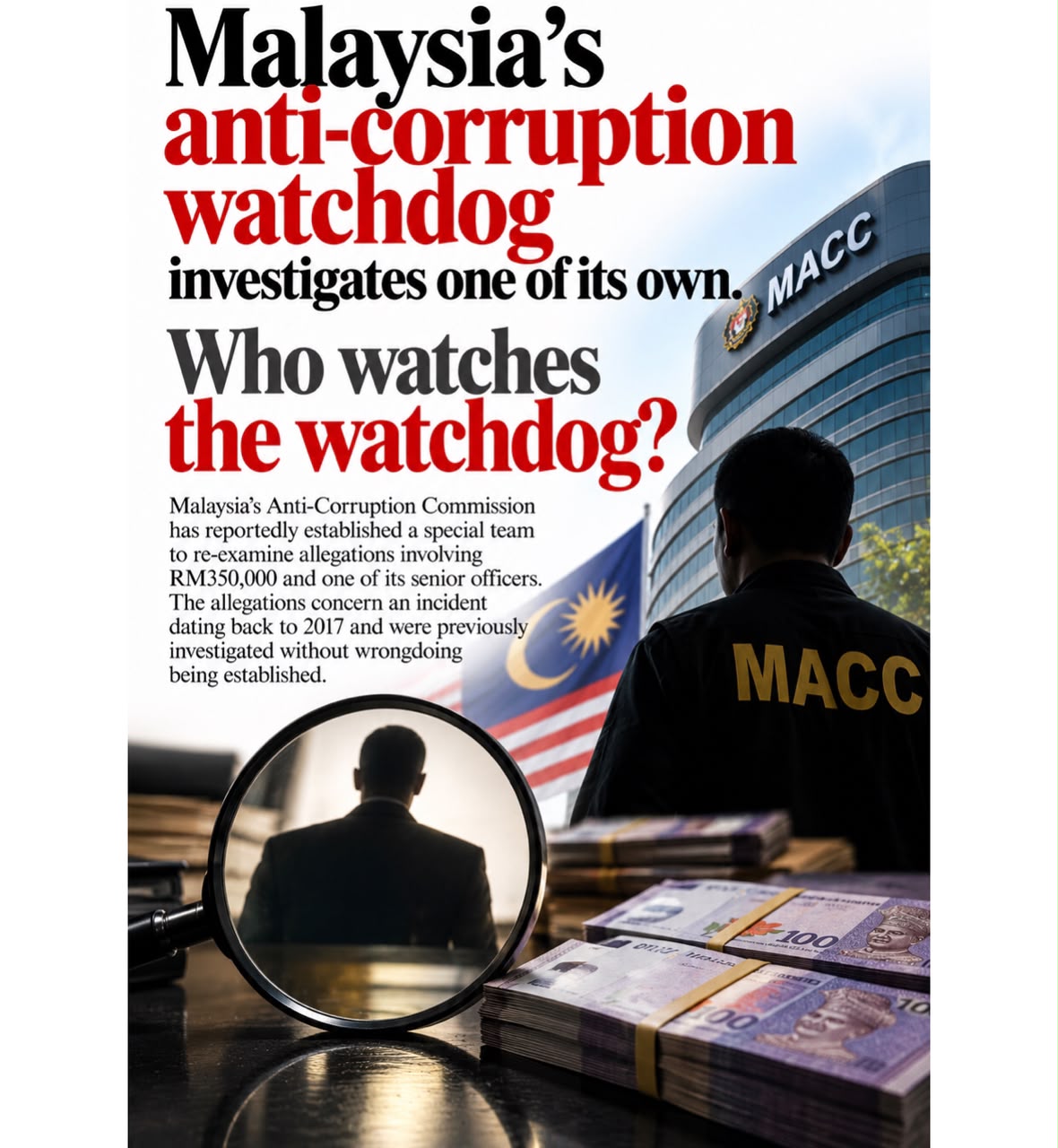
Malaysia’s Anti-Corruption Commission has reportedly established a special team to re-examine allegations involving RM350,000 and one of its senior officers. The allegations concern an incident dating back to 2017 and were previously investigated without wrongdoing being established. The decision to revisit the matter raises an important question for Malaysia, Sri Lanka and every country that claims to be serious about fighting corruption: who ensures accountability when allegations concern the investigators themselves?
An anti-corruption agency occupies an unusually powerful position within the machinery of government. It investigates allegations against politicians, public servants, businesspeople and other individuals suspected of abusing positions of trust. Its authority depends not simply on the powers granted by legislation, but on the confidence of the public that those powers will be exercised independently and without favour.
Malaysia’s Anti-Corruption Commission, widely known as the MACC, now finds itself confronting precisely that test.
Submit Your Press Release
Get your company news, announcements, launches, appointments and events in front of a wider audience.


Reports emerging on Sunday indicate that the Commission has established a special team to re-examine allegations involving RM350,000 and a senior officer. The matter reportedly relates to an incident in November 2017 and was investigated in 2018, when the authorities concluded that no wrongdoing had been established.
The allegations have resurfaced following renewed public attention and calls for scrutiny from Malaysian Corruption Watch.
The MACC has indicated that the renewed examination is intended to protect institutional integrity and maintain public confidence.
That decision deserves careful consideration, but it must not be interpreted as evidence that the allegations are true. The officer concerned remains entitled to the presumption of innocence, and the outcome of the earlier investigation cannot simply be disregarded because questions have subsequently been raised.
Nevertheless, the decision to reopen scrutiny presents an important institutional challenge.
When allegations concern an ordinary public official, the anti-corruption commission may be expected to investigate. But when allegations concern one of the commission’s own senior officers, the question of independence becomes considerably more complicated.
Can an institution credibly investigate itself? What safeguards prevent personal relationships, professional loyalties or institutional reputational concerns from influencing the outcome? Who determines whether an internal investigation has been sufficiently rigorous?
These are not questions unique to Malaysia.
Sri Lanka’s Commission to Investigate Allegations of Bribery or Corruption operates within a legal and political environment in which public confidence is equally important.
The country’s recent emphasis on accountability has placed considerable expectations on investigative institutions. Citizens have been encouraged to believe that the era of impunity is ending and that those entrusted with public power will be held answerable for misconduct.
But the credibility of that undertaking depends on the standards applied to the investigators themselves.
An anti-corruption institution cannot demand transparency from others while treating its own internal processes as matters beyond legitimate scrutiny.
This does not mean that every allegation against an investigator should result in suspension, public condemnation or disciplinary punishment. Such an approach would expose investigative officers to malicious complaints and could undermine their independence.
The proper response is a credible process that protects both the public interest and the rights of the individual concerned.
Where allegations involve senior officials, consideration should be given to independent oversight, external investigators or other arrangements capable of avoiding actual or perceived conflicts of interest.
The procedures adopted should be transparent enough to demonstrate that the allegations have been examined fairly, while protecting confidential evidence and the integrity of any continuing investigation.
There is also a broader question concerning institutional culture.
Anti-corruption agencies frequently operate under intense political pressure. Their investigations may involve influential individuals, substantial financial transactions and allegations capable of damaging reputations long before a court determines whether an offence has been committed.
For that reason, investigative integrity must be maintained at every stage, from the receipt of a complaint to the collection of evidence and the decision whether to pursue prosecution.
Malaysia’s renewed examination of the RM350,000 allegations provides an opportunity to demonstrate how such principles operate in practice.
If the allegations are unsupported, a credible investigation should establish that conclusion and explain it appropriately. If evidence of wrongdoing emerges, the authorities must act according to law, regardless of the officer’s position.
Sri Lanka would do well to follow the outcome.
The question is not whether Malaysia’s anti-corruption commission is more or less effective than its Sri Lankan counterpart. Such a conclusion would require a much broader assessment of their respective powers, safeguards and performance.
The more useful question is whether both countries possess sufficiently independent mechanisms to investigate allegations against those entrusted with investigating everyone else.
Be that as it may, the authority of an anti-corruption institution rests on a simple proposition: the standards it applies to the public must also apply within its own walls. When the investigators themselves become the subject of allegations, institutional credibility depends on the fairness, independence and transparency of the investigation that follows.