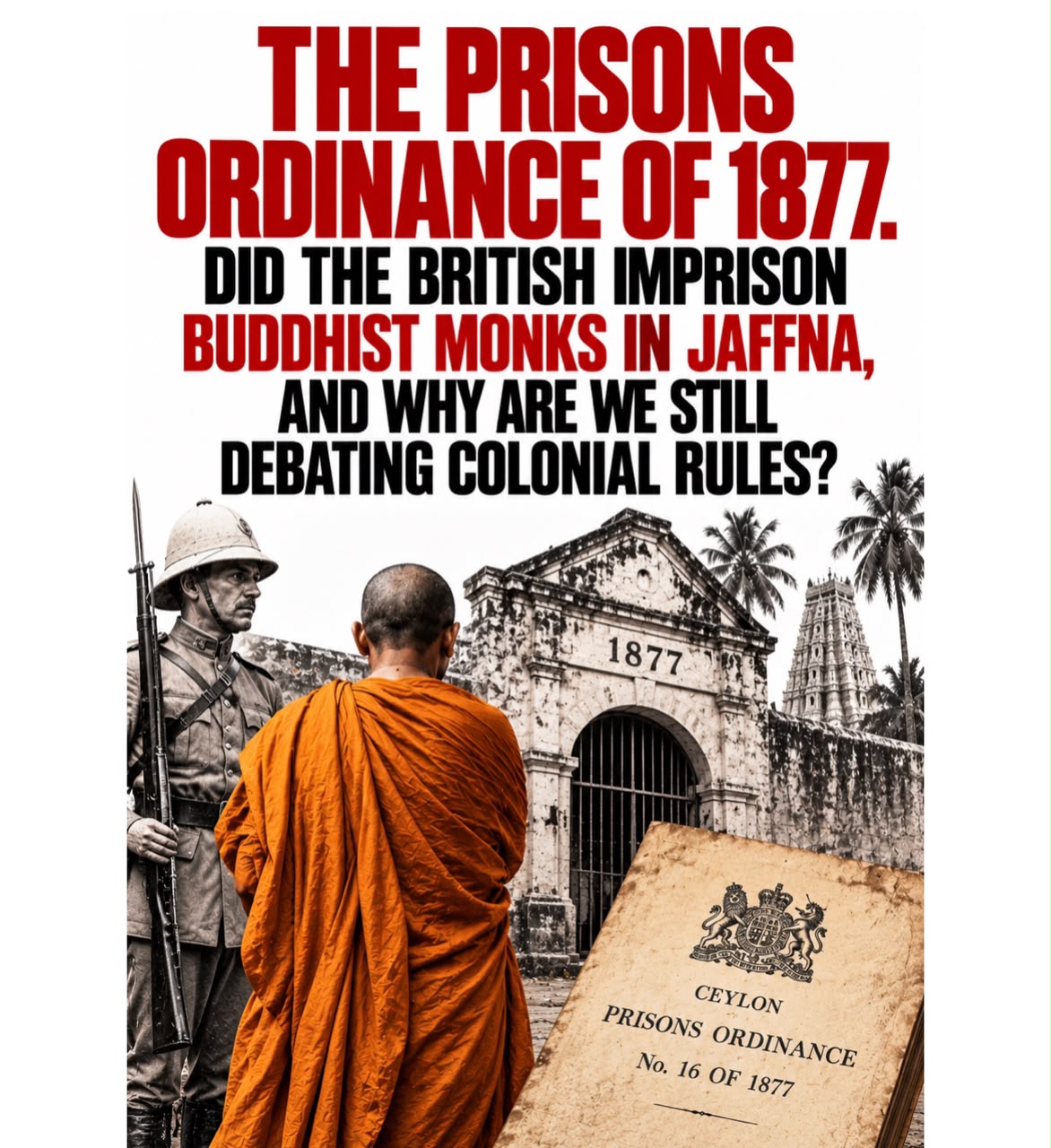
President Anura Kumara Dissanayake is reported to have referred to the colonial origins of Sri Lanka’s prison regulations during discussions with senior Buddhist clergy. A related historical claim concerns the imprisonment of Buddhist monks in Jaffna under British rule. The history deserves examination, but it does not remove the responsibility of successive independent governments to ensure that prison regulations comply with contemporary constitutional principles.
Sri Lanka’s debate over the treatment of Buddhist monks in prison has acquired an unusual historical dimension, with attention turning to the Prisons Ordinance of 1877 and the practices of the British colonial administration.
President Anura Kumara Dissanayake is reported to have discussed the colonial origins of prison regulations when he met senior Buddhist clergy following objections to the removal of monastic robes from a convicted monk.
Submit Your Press Release
Get your company news, announcements, launches, appointments and events in front of a wider audience.


A further claim concerns Buddhist monks allegedly imprisoned by the British in Jaffna and the treatment they received while in custody.
The historical proposition requires careful examination. The fact that a prison law originated during British rule does not establish that every regulation currently applied under it was introduced in 1877. Nor does it establish the circumstances in which particular monks may have been imprisoned.
The Prisons Ordinance, No. 16 of 1877, formed part of the legal framework established by the colonial administration for managing prisons and prisoners. Its provisions have been amended over time, while detailed administrative requirements have also been addressed through subordinate regulations.
The distinction between the principal Ordinance and regulations made under it is important. A provision concerning prisoners’ clothing may derive from a later regulation rather than the original colonial enactment.
If the Government intends to justify changes by reference to the historical treatment of Buddhist monks, it should identify the relevant legal provisions and documentary evidence.
The alleged Jaffna precedent deserves particular scrutiny.
Which monks were imprisoned? When were they arrested? What offences were alleged? Were they convicted by a court? What prison regulations were applied, and is there documentary evidence concerning the removal of their robes?
These are not trivial questions. Historical claims acquire considerable political force when repeated in discussions involving religion and national identity. That makes accuracy especially important.
British colonial rule undoubtedly involved the exercise of authority over religious institutions and communities. But a general understanding of colonial power cannot substitute for evidence concerning a particular imprisonment.
The more immediate issue is whether present prison regulations are compatible with Sri Lanka’s Constitution.
The Constitution recognises equality before the law, freedom of thought, conscience and religion, and the special position accorded to Buddhism. The State must reconcile those provisions when determining how religious practice may be accommodated in prisons.
The question is not whether Buddhist monks deserve dignity. Every person deprived of liberty deserves dignity.
The question is whether prison regulations can recognise genuine religious requirements without creating arbitrary distinctions between prisoners.
That examination should extend beyond Buddhist monks.
Sri Lanka is a country of several religious traditions. If the Government reviews prison rules concerning religious clothing, the exercise should consider the requirements of other faiths and the practical needs of prison administration.
Security, identification, hygiene and discipline are legitimate considerations. They should be examined transparently rather than invoked as convenient explanations for decisions already taken.
There is also a broader question concerning the continued operation of colonial legislation.
Sri Lanka obtained independence in 1948 and became a republic in 1972. Since then, successive governments have possessed the legislative authority to review and amend inherited laws.
If a colonial provision is inconsistent with contemporary constitutional values, the responsibility for correcting it rests with the institutions of the independent State.
The British administration may have enacted the original law. It has not been responsible for administering Sri Lanka’s prisons for nearly eight decades.
That distinction is worth remembering whenever colonial history is offered as an explanation for present administrative arrangements.
The Government’s proposed review provides an opportunity to examine prison regulations comprehensively. Such a review should consider religious accommodation, healthcare, overcrowding, rehabilitation, disciplinary procedures and the treatment of remand prisoners.
It should also establish clear standards capable of being applied consistently, irrespective of a prisoner’s social standing or political connections.
The public deserves a system governed by law rather than improvised responses to controversy.
Be that as it may, blaming the British for a law enacted in 1877 may explain where it originated. It does not explain why independent Sri Lanka has taken so long to decide whether it should remain unchanged.